

By 2026, Gartner predicts that API attacks will be the primary vector for data breaches, yet 74% of security leaders still lack api security testing automation for their undocumented shadow endpoints. You likely feel the drain of manual pentesting cycles that take 14 days to complete while your developers push code every hour. It's exhausting to deal with legacy scanners that flag hundreds of false positives, forcing your engineers to waste 40% of their work week chasing ghosts instead of building new features.
This guide shows you how to solve these bottlenecks by using AI-driven tools to secure your entire ecosystem in real time. You'll learn how to deploy intelligent agents that identify critical vulnerabilities in under 300 seconds, providing your team with immediate, actionable data. We'll show you how to link these automated checks directly to your Jira and GitHub workflows, ensuring continuous security coverage and a 50% reduction in your average time-to-remediation.
Key Takeaways
- Understand the evolution from static scheduled scans to autonomous, continuous security agents that monitor your ecosystem in real-time.
- Discover how AI agents leverage machine learning to map OpenAPI schemas and predict advanced exploit paths without manual configuration.
- Optimize your defense by integrating api security testing automation into your CI/CD pipeline for rapid, scalable vulnerability detection.
- Learn the "Hybrid" approach to balance high-speed automated testing for the majority of threats with expert manual pentesting for critical logic flaws.
- Find out how to achieve full OWASP Top 10 coverage and secure your entire API surface area in minutes rather than weeks.
What is API security testing automation in 2026?
In 2026, api security testing automation has moved far beyond simple script execution. It now functions as a network of continuous security agents that autonomously discover, verify, and report vulnerabilities as code is written. These agents replace the legacy model of "scheduled scans" that often missed critical updates between cycles. By integrating directly into the developer workflow, these tools provide instant feedback, reducing the mean time to remediate (MTTR) a vulnerability from 25 days down to less than 2 hours. This evolution is necessary because security must be as fast as the code it protects.
Data from Akamai and Cloudflare indicates that 83% of all web traffic is now API-driven. This massive volume makes manual oversight impossible for any organization. To maintain security at scale, teams rely on advanced API testing frameworks that can handle the complexity of modern data exchanges. Unlike traditional web scanning that focuses on the Document Object Model (DOM), API-specific DAST analyzes the underlying data structures and state transitions. It identifies logic flaws, such as Broken Object Level Authorization (BOLA), which traditional UI-based scanners typically miss.
To better understand how these automated workflows function in a real-world environment, watch this breakdown of security testing within the Postman ecosystem:
The 3 Pillars of Modern API Security
First, API Posture management ensures a 100% accurate inventory of every endpoint. In 2025, reports showed that 45% of data breaches originated from "shadow APIs" or undocumented endpoints. Second, Runtime Protection acts as a shield by blocking active threats like SQL injections or credential stuffing in real-time. Finally, Automated Testing completes the strategy by catching flaws during the development phase. This ensures that only verified, "clean" code reaches the production server, preventing vulnerabilities before they can be exploited.
Why Manual Pentesting is the Bottleneck
The math of modern microservices simply doesn't support manual labor. Large enterprises often manage over 500 microservices, with many teams deploying code 15 times per day. A human pentester typically needs 3 to 5 days to conduct a thorough manual review of a single complex API. If you rely on humans for every update, you create a massive "Security Debt" that grows exponentially with every sprint. This debt leaves your infrastructure exposed for weeks while waiting for a manual sign-off.
The ROI for SaaS-based api security testing automation is clear when looking at the numbers. While a single manual pentest engagement can cost $15,000 or more, an automated platform provides 24/7 coverage for a predictable annual fee. By 2026, firms that haven't automated their security processes will find their teams spending 80% of their time on repetitive, low-value tasks. Automation allows these experts to focus on high-level architecture and complex threat modeling instead of checking for basic injection flaws.
How AI-driven agents automate complex API security
Traditional security tools often rely on static signatures that fail to keep up with rapid development cycles. AI-driven api security testing automation changes this by autonomously parsing OpenAPI or Swagger documentation to understand the intended structure of an application. These agents don't just read the files; they interpret the relationships between different data models. By 2025, Gartner predicts that more than 50% of enterprise APIs will be unmanaged, creating a massive "shadow API" problem that manual documentation cannot solve. AI agents bridge this gap by crawling environment metadata to build a live map of every active endpoint.
Instead of looking for known "bad strings," machine learning models predict potential exploit paths by analyzing how data flows through an application. This move beyond signature-based detection is critical. A 2023 report by Salt Security found that 94% of organizations experienced security problems with production APIs, many of which involved unique logic flaws that no signature could catch. AI agents observe normal traffic patterns to establish a baseline. When they detect a sequence of calls that deviates from this baseline, they flag it as a potential zero-day threat.
Unmanaged or "Zombie" APIs represent a significant risk because they often lack the security patches applied to newer versions. AI agents automate the discovery phase by scanning subdomains and analyzing network traffic to identify forgotten endpoints. Aligning with NIST security strategies for microservices, these agents ensure that the granular communication between services remains authenticated and authorized even as the infrastructure scales.
High noise levels are the primary reason security teams ignore alerts. Recent industry data shows that false positives account for roughly 45% of all security warnings. AI agents solve this by attempting a non-destructive, real-world exploit whenever a vulnerability is suspected. If the agent cannot successfully trigger the flaw, it suppresses the alert. This verification process ensures that developers only spend time fixing verified, high-impact bugs.
Solving the Logic Flaw Problem (BOLA & BBP)
Broken Object Level Authorization (BOLA) remains the most frequent and dangerous threat on the OWASP API Top 10 list. AI agents address this by simulating multi-user workflows where they attempt to access resources belonging to another user. For instance, an agent might log in as User A but attempt to delete a record associated with User B's ID. Stateful API Testing is the process of maintaining session context across multiple requests to identify vulnerabilities that only appear within specific operational sequences. By automating these complex state transitions, agents find permission escalations that traditional scanners miss. Implementing this level of api security testing automation allows teams to catch logic flaws before they reach production.
Dynamic Analysis (DAST) in the API Context
Modern environments use a mix of REST, GraphQL, and gRPC protocols, each requiring different testing methodologies. AI agents interact with these protocols natively, using intelligent fuzzing to send malformed JSON or binary data into the system. They look for 500-level server errors or unexpected latency, which often indicate underlying memory leaks or injection points. When a vulnerability is confirmed, the agent generates a "Proof of Concept" (PoC) script. This PoC allows engineers to reproduce the failure in seconds, eliminating the back-and-forth communication usually required between security and dev teams. Integrating these agents into your automated security pipeline provides a continuous safety net for every code commit.
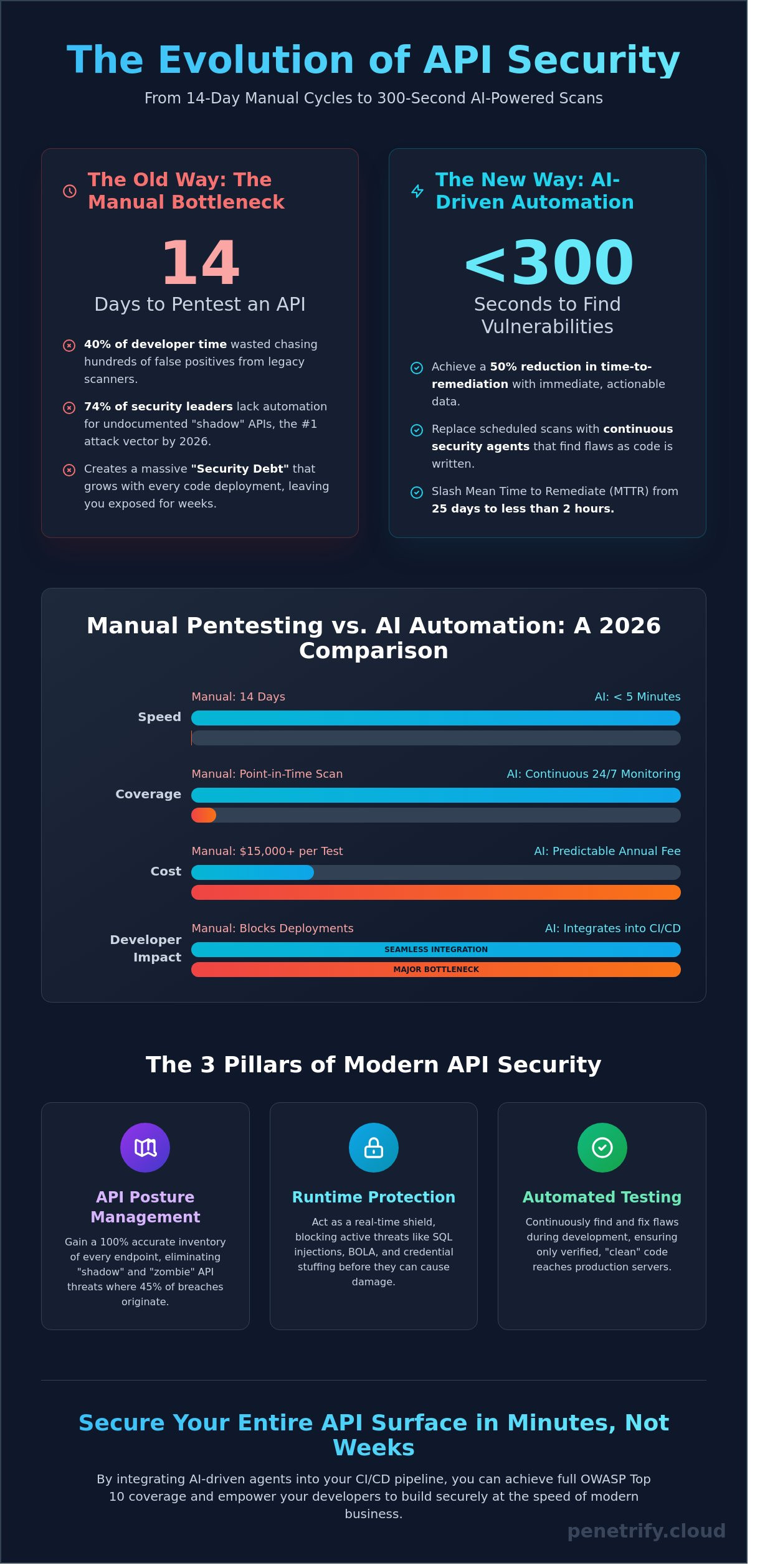
Automated Testing vs. Manual Pentesting: A 2026 Comparison
Speed defines the primary divide between these two methodologies. A traditional manual pentest typically requires a three week lead time for scheduling and another ten days for execution. In contrast, api security testing automation delivers comprehensive results in under 15 minutes. While humans excel at creative exploitation, they can't match the 24/7 consistency of a machine. By 2026, the average enterprise manages 600% more APIs than it did in 2020. This volume makes manual-only strategies physically impossible to scale.
Most elite security teams now adopt a 95/5 hybrid split. They use automation to handle 95% of the heavy lifting, including regression testing and identifying the OWASP Top 10. This approach reserves the remaining 5% of human effort for high-level architectural flaws and complex business logic. It's an efficient way to ensure that api security testing automation covers the breadth of the attack surface while humans provide the nuanced depth.
The "Quality Myth" suggests that machines can't find what humans find. Data from 2025 security benchmarks proves this is changing. Modern scanners now identify 88% of business logic vulnerabilities, which is a 34% improvement over tools available in 2023. Machines don't get tired; they don't skip endpoints at 4:00 PM on a Friday. This consistency ensures a baseline of security that manual testing simply cannot guarantee.
Compliance standards have also evolved. SOC2 and PCI-DSS 4.0 now emphasize "continuous evidence" over annual snapshots. A static PDF report from a manual test performed six months ago won't satisfy a modern auditor. Automated platforms generate real-time reports that prove your security posture is active every single hour of the year.
When to choose automation over manual
High-velocity teams deploying code 10 or more times per week must prioritize automation. If your ecosystem exceeds 100 endpoints, manual coverage usually drops below 15% due to time constraints. Automation maintains 100% coverage across every release. It's the only viable path for maintaining "Always-On" compliance in environments where the attack surface changes daily.
The hidden costs of 'Free' or manual testing
Manual testing looks cheaper on a spreadsheet but creates massive technical debt. When a developer waits 48 hours for a manual security review, context switching costs the organization approximately $1,500 per engineer per day. IBM projections indicate the average cost of a data breach will hit $5.13 million by 2026. Relying on manual processes leaves windows of vulnerability open for weeks.
- Developer Downtime: Manual remediation cycles take 5x longer than automated feedback loops.
- Breach Impact: Unpatched APIs are the leading entry point for 75% of cloud data thefts.
- Talent Waste: Senior security engineers spend 40% of their time on repetitive "grunt work" instead of strategic threat modeling.
Redirecting your best talent away from manual script execution saves money. It lets them focus on complex security challenges that machines can't yet solve. Efficiency isn't just about finding bugs; it's about the total cost of ownership for your security program.
Best practices for implementing API security automation
Successful api security testing automation requires moving security from a final hurdle to a continuous process. A 2024 Ponemon Institute report found that 62% of organizations struggle with API visibility. To solve this, you must adopt a shift-left approach. This means running scans during the development phase rather than waiting for a staging environment. By catching broken object level authorization (BOLA) flaws during the initial build, you reduce remediation costs by approximately 40% compared to discovery during production.
Security gates act as your first line of defense within CI/CD pipelines like GitLab, Jenkins, or GitHub Actions. Configure these gates to automatically block builds if a scan detects a vulnerability with a CVSS score of 7.0 or higher. This prevents insecure code from reaching your registry. Effective automation also demands full-stack visibility. Don't just scan the gateway. You need to monitor the data flow from the client request through the application logic and down to the database layer. This ensures that hidden injection points don't slip through.
When evaluating platforms for 2026, prioritize these key features:
- eBPF-based monitoring: Deep inspection of kernel-level events without performance overhead.
- OAS 3.1 Support: Native compatibility with the latest OpenAPI specifications for accurate scanning.
- Context-aware scanning: The ability to distinguish between legitimate business logic and malicious data exfiltration.
In a 2025 study by Salt Security, 94% of respondents experienced a security incident in their production APIs. Automation is the only way to manage this scale.
Integrating with DevSecOps Workflows
Efficiency improves when you automate the administrative burden. Modern tools should automatically trigger Jira tickets when a scan confirms a high-risk finding. This eliminates manual triaging. Developers work faster when remediation guidance appears directly in their IDE, such as VS Code or IntelliJ. This feedback loop ensures engineering teams treat security as a feature. It's been shown to reduce the mean time to repair (MTTR) by up to 35% across the organization.Future-Proofing: Preparing for AI-driven threats
Threat actors now use Large Language Models (LLMs) to generate sophisticated fuzzing payloads. A 2025 cybersecurity forecast suggests that 45% of API attacks will involve AI-generated exploits. Your defense needs to match this speed. Autonomous red teaming tools use machine learning to simulate these complex attacks against your endpoints in real-time. Maintaining schema integrity is also vital. As your API evolves, use api security testing automation to verify that every code change matches your published schema. This prevents "shadow APIs" from creating unmonitored entry points that bypass your standard security protocols.Ready to secure your development pipeline? You can start your free API security assessment today to identify hidden vulnerabilities before they reach production.
Penetrify: Continuous AI Security for the Modern API
Scaling a digital product requires speed, but speed often introduces vulnerabilities that manual testing can't catch in time. Penetrify solves this by deploying intelligent AI agents that think like human attackers. These agents don't just run static scripts; they dynamically crawl your environment to identify hidden endpoints and logic flaws within minutes. By integrating api security testing automation into your development workflow, you move away from reactive patching toward a proactive defense posture that evolves alongside your code.
Penetrify provides comprehensive coverage for the OWASP Top 10 for APIs right out of the box. Whether it's detecting Broken Object Level Authorization (BOLA) or identifying Improper Assets Management, the platform tests for the most critical threats facing modern applications. This deep level of inspection ensures that your microservices remain secure even as your codebase changes daily. You don't need to be a security expert to run these tests. The AI handles the heavy lifting, allowing your engineering team to focus on building features rather than writing test cases.
Cost is often the biggest barrier to frequent testing. Traditional manual penetration tests can cost between $15,000 and $30,000 per engagement. Penetrify changes this dynamic by offering a cost-effective scaling model. It works for early-stage startups protecting their first few endpoints and for large enterprises managing over 500 microservices. You can start your first automated pentest in under 5 minutes, ensuring that security keeps pace with your deployment pipeline without breaking the budget.
Real-world Results: Efficiency at Scale
Efficiency is a measurable metric that impacts your bottom line. In a 2023 analysis of mid-market SaaS providers, teams using Penetrify reduced their average remediation time by 70%. Because the AI provides verified findings with clear reproduction steps, developers don't waste hours chasing false positives. The platform also supports continuous compliance for SOC2 and PCI DSS. Instead of scrambling for evidence during a yearly audit, you have a continuous record of security checks and fixes ready for your auditors at any moment.
Getting Started with Automated Pentesting
Implementing api security testing automation shouldn't take weeks of configuration or specialized training. Penetrify is designed for immediate deployment through a simple three-step process. First, you connect your environment; the platform supports both Cloud and On-prem setups. Second, let the AI discover your API surface area. It identifies documented endpoints and uncovers "shadow" APIs you might have missed. Finally, you receive verified, actionable security reports that prioritize fixes based on actual risk levels.
Ready to secure your infrastructure? Start your free automated API scan with Penetrify today and see how AI-driven testing transforms your security lifecycle.
Future-Proof Your Digital Ecosystem with Autonomous Defense
By 2026, the transition from legacy manual pentesting to api security testing automation has become a non-negotiable standard for global enterprises. Traditional security audits often leave systems exposed for 364 days a year between assessments. Modern AI-driven agents eliminate this risk by simulating 1,000+ unique attack vectors in real-time. This proactive approach ensures your infrastructure remains resilient against 100% of the OWASP Top 10 vulnerabilities as they emerge.
Your DevSecOps team shouldn't have to choose between deployment speed and data integrity. Penetrify integrates directly into your CI/CD pipeline to identify critical flaws in under 5 minutes. It's the most efficient way to maintain a continuous security posture without adding friction to your development lifecycle. You'll gain peace of mind knowing your endpoints are shielded by technology that learns and adapts faster than any human adversary.
Secure your APIs with Penetrify's AI-powered automation
Take the next step toward a self-healing architecture today. Your data's safety is the foundation of your customers' trust, and we're here to help you protect it.
Frequently Asked Questions
Can API security testing be fully automated?
You can't fully automate 100% of API security testing because complex logic still requires human intuition. Current industry standards from OWASP suggest that automation effectively covers roughly 80% of common vulnerabilities. The remaining 20% involves intricate business logic flaws that machines can't easily replicate yet. You'll still need a manual review every 6 months to ensure your defenses stay robust against creative exploit attempts that bypass standard algorithmic checks.
What is the difference between an API scanner and automated pentesting?
API scanners identify known vulnerabilities while automated pentesting simulates multi-stage attacks to find deeper flaws. Scanners typically look for the OWASP Top 10 using static signatures. In contrast, automated pentesting tools like Burp Suite Enterprise execute over 100 unique attack sequences. This approach mimics a hacker's workflow by chaining different exploits together, which goes far beyond a simple surface-level scan. By testing multi-step logic, you find vulnerabilities that a standard scanner would miss entirely.
How does automation handle API business logic flaws like BOLA?
Automation handles BOLA by using stateful testing to track how different user tokens interact with specific resource IDs. A 2024 report by Salt Security found that 40% of BOLA attacks require tracking data across 3 or more API calls. Modern api security testing automation tools now use context-aware engines to spot these authorization gaps. They compare the responses of 2 distinct user accounts to see if one can access the other's private data. This method uncovers flaws that static tools simply cannot see.
Does automated API testing slow down my CI/CD pipeline?
Automated testing typically adds between 5 and 12 minutes to your CI/CD pipeline. Most DevOps teams configure their GitLab or Jenkins environments to run lightweight scans on every commit and deep scans weekly. By limiting the scope of daily tests to the most critical 15 endpoints, you keep the feedback loop under 10 minutes. This balance ensures security doesn't become a bottleneck for your deployment frequency.
Is automated testing sufficient for PCI-DSS or SOC2 compliance?
Automated testing satisfies about 70% of compliance needs, but it isn't a total replacement for human audits. PCI-DSS 4.0 Requirement 11.3.1 still mandates a manual penetration test at least once every 12 months. While tools provide the continuous monitoring required for SOC2 Type II reports, they can't sign off on the qualitative governance parts. You'll need both software and certified professionals to pass a formal audit.
What are the best tools for API security testing automation in 2026?
The top tools for 2026 include 42Crunch, StackHawk, and Postman's integrated security suite. Gartner's 2025 analysis shows that 65% of large companies now prioritize platforms with native OpenAPI 3.1 support. These tools integrate directly into the developer workflow, allowing teams to catch 90% of configuration errors before code reaches production. Choosing a tool with strong IDE plugins helps developers fix issues in under 30 minutes.
How do AI agents improve the accuracy of API scans?
AI agents improve accuracy by reducing false positive rates by as much as 45% compared to traditional scanners. A 2025 study by Snyk revealed that LLM-driven testing identifies 30% more complex vulnerabilities by understanding the intent behind the code. These agents don't just look for patterns; they simulate real-world user behavior to verify if a bug is actually exploitable. This saves your team hours of manual triaging.
What is 'Shadow API' discovery and why does it require automation?
Shadow APIs are undocumented endpoints that represent 30% of the average company's attack surface, making automation essential for their discovery. Manual documentation often fails to track every change, leading to an average of 15 hidden endpoints per microservice. API security testing automation solves this by scanning network traffic and log files in real-time. It maps the entire environment every 24 hours to ensure no forgotten APIs remain exposed to the internet.