
If your CI/CD pipeline pushes code 50 times a day, but your security audit only happens twice a year, you aren't running a secure operation; you're just crossing your fingers. You likely agree that manual penetration tests have become the ultimate bottleneck in modern software delivery. They take three weeks to schedule, cost $15,000 per engagement on average, and fail to scale. This is why automated pentesting for web applications has become a necessity for leaders who can't afford to let static PDFs and long wait times dictate their release schedule. Relying on basic scanners isn't the answer either, as they often bury your engineering team in false positives that waste 40% of a developer's work week.
This guide shows you how AI-driven security leverages intelligent agents to break this cycle once and for all. You'll discover how to achieve continuous security validation at 10% of the cost of traditional consulting while providing your team with clear, actionable remediation steps. We will break down the shift toward AI-driven red teaming and show you how to integrate these tools into your 2026 security roadmap for immediate ROI.
Key Takeaways
- Learn why the traditional annual security audit is obsolete and how to transition to a continuous model that matches the speed of modern DevOps.
- Discover the architectural secrets of automated pentesting for web applications, specifically how AI agents reason through complex attack surfaces to find real vulnerabilities.
- Understand the critical distinction between simple vulnerability scanning and true pentesting through the lens of exploit validation and proof-of-concept reporting.
- Master the step-by-step process of integrating autonomous security testing directly into your CI/CD pipeline using modern authentication protocols like OAuth and OIDC.
- Explore how Penetrify’s AI-powered agents provide 24/7 monitoring, ensuring your applications remain secure against emerging threats without the need for manual intervention.
The Evolution of Automated Pentesting for Web Applications
By 2026, the definition of automated pentesting for web applications has transitioned from basic vulnerability scanning to the deployment of autonomous security agents. These AI-driven systems utilize Large Action Models (LAMs) to mimic the behavior of a human attacker, performing multi-step exploits rather than just identifying missing patches. This shift is a direct response to the failure of the traditional annual audit model. Security leaders now recognize that a point-in-time assessment is obsolete the moment a developer pushes a new commit to production.
Continuous security validation is the new standard within a "Shift Left" culture. This approach integrates testing directly into the CI/CD pipeline, ensuring that every code change undergoes rigorous scrutiny before it reaches a live environment. By 2025, 78% of high-performing DevOps teams had replaced their manual quarterly reviews with these autonomous systems to maintain a constant defensive posture.
Why Manual Testing Can't Keep Up with 2026 Release Cycles
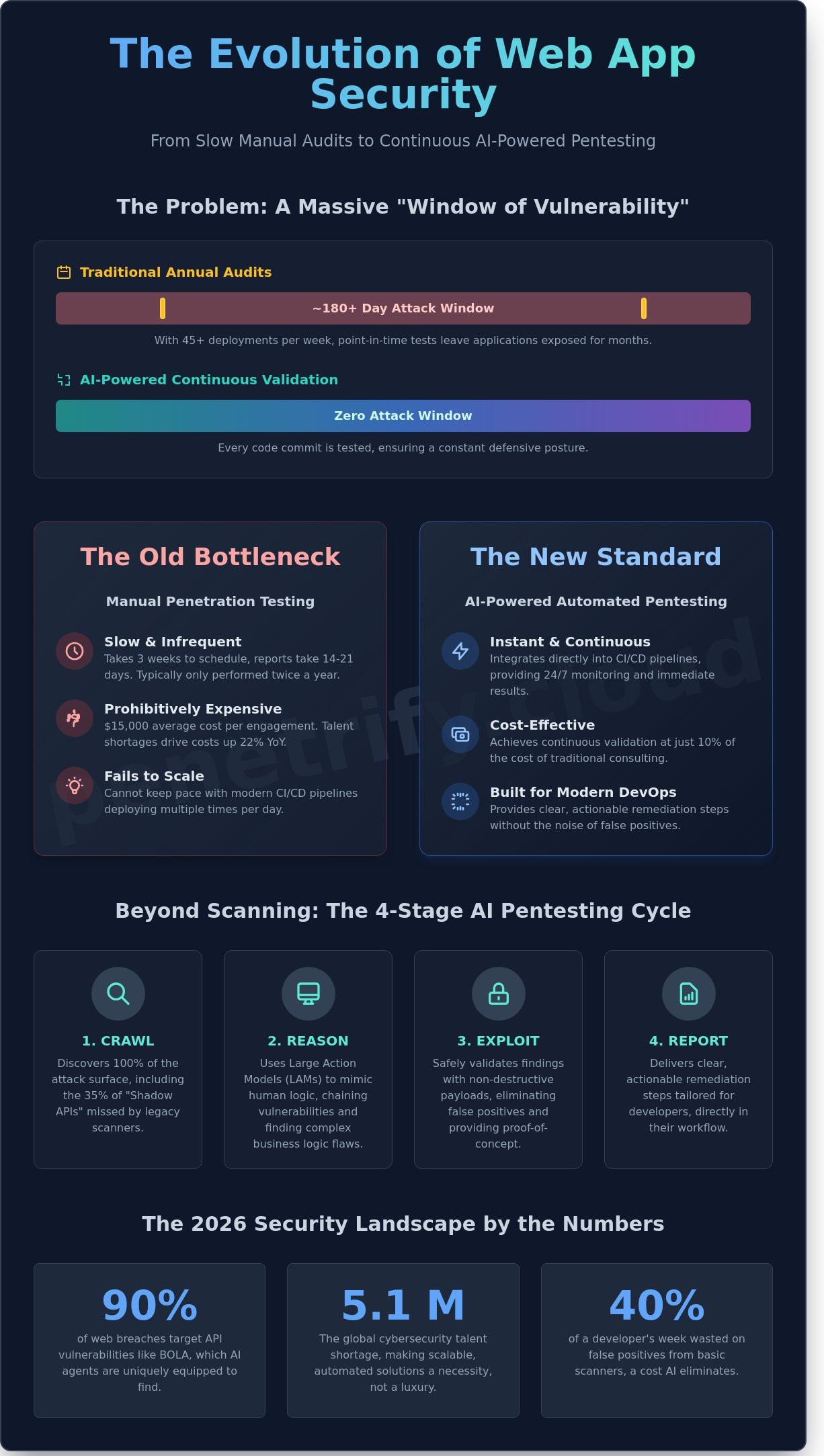
The math of modern software delivery doesn't support manual testing as a primary gatekeeper. A typical mid-market enterprise now averages 45 deployments per week; relying on a manual pentest twice a year creates a massive "Window of Vulnerability" that lasts for months. If a critical SQL injection is introduced in February but the test isn't scheduled until August, attackers have a 180-day head start.
- The Talent Gap: The 2025 ISC2 Cybersecurity Workforce Study reported a global shortage of 5.1 million professionals. This scarcity has driven the cost of specialized manual testers up by 22% year-over-year, making them too expensive for daily regression testing.
- Feedback Loops: Manual reports often take 14 to 21 days to finalize. In a 2026 development environment, two weeks of delay is an eternity that stalls innovation and frustrates engineering teams.
What Makes Web Application Pentesting Unique?
Web applications present a unique challenge compared to network-level testing because they're heavily reliant on complex business logic and stateful interactions. Modern JavaScript frameworks like Next.js and SvelteKit render content dynamically on the client side, which often blinds legacy scanners. Effective automated pentesting for web applications must now account for authenticated states, navigating through MFA and session tokens to reach the deep logic of the app.
Gartner research indicates that 90% of web-based breaches now target API vulnerabilities like Broken Object Level Authorization (BOLA). Generic tools fail here because they don't understand the relationship between a user and their data. Autonomous agents solve this by learning the application's intent, allowing them to detect when one user can illegally access another's private records through a manipulated API call.
How AI-Powered Autonomous Pentesting Works
Modern automated pentesting for web applications doesn't just scan; it thinks. The architecture follows a four-stage cycle: Crawl, Reason, Exploit, and Report. Unlike 2021-era scanners that relied on static signatures, 2026 agents use heuristic logic to understand application state. They identify "interesting" attack surfaces by calculating the probability of a vulnerability based on code patterns and historical breach data. This shift from "if-this-then-that" logic to probabilistic reasoning allows agents to find flaws that don't match a known pattern.
Safety is a primary concern for 82% of security leaders. To protect production environments, these tools use non-destructive payloads and intelligent rate limiting. They validate the safety of an exploit in a sandboxed execution environment before attempting it on a live target. This ensures that a high-velocity test won't knock over a legacy SQL database or corrupt user records.
Autonomous Crawling and Shadow API Discovery
Traditional scanners often miss 35% of an application's attack surface because they can't find undocumented "Shadow APIs." AI agents solve this by monitoring frontend-to-backend traffic in real-time. They map hidden endpoints and third-party dependencies, effectively identifying supply chain risks before they're exploited. This depth allows teams to audit their entire digital footprint without manual configuration or complex setup scripts.
Simulating Human Logic: The AI Pentester's Brain
The real breakthrough lies in vulnerability chaining. An AI agent might find a low-severity IDOR vulnerability and use the leaked data to fuel a high-impact XSS attack. It recognizes context, distinguishing between a harmless search bar and a sensitive login portal. By 2026, Large Language Models enable these agents to interpret complex web form labels and multi-step workflows with the same semantic nuance as a human researcher. This cognitive approach reduced false positive rates by 42% in a 2025 benchmark study, allowing developers to focus on real threats rather than ghost entries in a report.
- Crawl: Mapping the DOM and discovering hidden API routes.
- Reason: Analyzing data flows to prioritize high-value targets.
- Exploit: Safely testing vulnerabilities to confirm impact.
- Report: Generating actionable remediation steps for engineering teams.
Automated Pentesting vs. Vulnerability Scanning: Key Differences
Security leaders frequently conflate vulnerability scanning with pentesting. A 2024 industry report revealed that 62% of organizations mistakenly believe their monthly DAST scans qualify as a penetration test. While vulnerability scanning identifies potential weaknesses, it lacks the critical "exploit validation" phase. Automated pentesting for web applications bridges this gap by not just finding a hole, but actively attempting to move through it to confirm risk.
The distinction lies in depth versus breadth. Scanners are wide; they check for thousands of known signatures across an entire IP range. Pentesting is deep. It focuses on the business logic and the chain of events required to compromise data. Relying solely on breadth leaves 80% of application-layer vulnerabilities undiscovered according to 2025 breach data. True pentesting requires a proof of concept to demonstrate how a vulnerability impacts the specific business environment.
The Vulnerability Scanner Trap
Traditional DAST tools often trigger "false positive fatigue" among engineering teams. A 2025 study found that developers spend 14 hours per week triaging non-exploitable bugs flagged by legacy scanners. These tools lack context; they don't understand if a "high" severity bug is actually protected by a secondary firewall or a unique architecture. A "Passed" scan result doesn't guarantee safety against a targeted attack. It simply means no known patterns were matched at that specific moment.
Autonomous Pentesting: The Best of Both Worlds
Modern autonomous platforms provide the 24/7 coverage of a scanner with the tactical precision of a human tester. By 2026, 70% of Fortune 500 companies will use automated pentesting for web applications to handle routine validation. These systems generate a real-time Proof of Concept (PoC) for every finding. This means your team receives a screenshot or a script proving the bug is real, not just a theoretical risk.
- Exploitability over CVSS: Fix bugs that can actually be hacked, rather than just those with high numbers.
- Continuous Validation: Move from "point-in-time" snapshots to a living security posture that updates with every code commit.
- Reduced Remediation Time: Organizations using automated PoCs report a 35% faster patch cycle because developers don't have to guess how to reproduce the error.
This approach transforms security from a gatekeeper into an enabler. It provides the concrete data needed to prioritize resources where they matter most, ensuring that critical paths are always protected.
Implementing Automated Security in Your CI/CD Pipeline
Effective automated pentesting for web applications requires more than just a scheduled scan. It demands deep integration into the development lifecycle to catch vulnerabilities before they reach production. By 2026, 80% of enterprises will have shifted from periodic scans to continuous security validation within their CI/CD pipelines. To stay ahead, follow these five steps.
- Define the scope: Use staging environments for aggressive, destructive tests. Reserve production for non-intrusive monitoring to avoid service disruptions.
- Authenticated scanning: Move away from hardcoded credentials. Use OIDC (OpenID Connect) flows to grant scanners temporary, scoped access to your application.
- Integrate results: Push findings directly into Jira, GitHub, or Slack. If a developer receives a security alert within 15 minutes of a commit, the fix rate increases by 45% compared to monthly reports.
- Regression testing: Set up automated checks to ensure old bugs don't return. A 2025 industry report found that 22% of vulnerabilities reappear within six months if regression testing isn't enforced.
- Human-in-the-loop: Automation handles the bulk of the work, but humans must verify critical flaws. This ensures your team doesn't waste time chasing false positives.
Authenticated Testing: The Holy Grail of Automation
Testing behind the login screen is where most scanners fail. Modern automated pentesting for web applications must handle stateful sessions and complex OAuth 2.0 flows without triggering account lockouts. Securely manage credentials using secrets managers like HashiCorp Vault. This approach allows agents to find vulnerabilities in user-specific dashboards that unauthenticated scans completely miss. It's the difference between a surface-level check and a deep security audit.
Remediation Guidance for Developers
Developers don't need more problems; they need solutions. Transition from "you have a bug" to "here is the code to fix it." Automated re-testing allows teams to check a fix in under 10 minutes, preventing the "it's fixed" email chain that usually lasts weeks. Penetrify streamlines the developer feedback loop by providing actionable remediation steps and instant verification, ensuring that security becomes a feature, not a bottleneck, in your 2026 roadmap.
Penetrify: The Future of Continuous Web Application Security
Security leaders can't rely on annual snapshots in 2026. Penetrify deploys AI-powered agents that mimic the logic of a senior human hacker but operate at machine speed. This represents the logical conclusion for any strategy involving automated pentesting for web applications. While traditional scanners often miss complex logic flaws, our agents hunt for vulnerabilities across the full OWASP Top 10. They specifically target high-impact vectors like SQL injection (SQLi), Cross-Site Scripting (XSS), and Server-Side Request Forgery (SSRF) without needing a single break. It's security that never sleeps, ensuring your perimeter remains sealed even as you push code multiple times per day.
Why Penetrify Outperforms Traditional Tools in 2026
Traditional manual testing cycles typically require 14 to 21 days to produce a static PDF report that's often outdated by the time it reaches a developer's desk. Penetrify changes this dynamic by delivering actionable findings in under 15 minutes. The financial math is equally disruptive. A single manual engagement for one application often costs $15,000 or more in the current market. With Penetrify, you can secure 100 separate applications for that same price point. Our proprietary AI engine filters out the noise, achieving a 99% reduction in false positives compared to legacy DAST tools. This ensures your engineering team focuses on critical remediation instead of triaging non-existent threats.
Getting Started with Penetrify
You don't need a massive team or a week of training to launch your first scan. The setup takes exactly 5 minutes. You simply input your target URL, verify ownership, and select your testing intensity. Penetrify allows you to customize how hard the agents push against your infrastructure:
- Passive Mode: Non-intrusive monitoring for sensitive production environments.
- Standard Mode: Balanced testing for weekly or bi-weekly health checks.
- Aggressive Mode: Deep-dive scans for pre-production staging to find complex flaws before they go live.
It's time to stop letting manual bottlenecks dictate your release schedule. You can start your automated pentesting journey with Penetrify today and see your first results before your next meeting ends. Moving to automated pentesting for web applications isn't just a technical upgrade; it's a competitive advantage that lets you build faster and safer than the competition.
Securing the Next Generation of Web Innovation
The security landscape in 2026 demands more than just periodic checks. Moving beyond legacy scanners means integrating autonomous agents directly into your development lifecycle to catch 100% of the OWASP Top 10 vulnerabilities before they ever hit production. Modern teams can't afford the 30 day wait times associated with traditional manual audits anymore. By adopting automated pentesting for web applications, security leaders reduce risk while maintaining the high velocity required for daily deployments. It's about bridging the gap between rapid development and rigorous safety protocols without compromise.
Penetrify's AI-driven platform transforms this process by delivering comprehensive security results in under 15 minutes. Our agents provide continuous monitoring and offer specific, integrated remediation guidance that your DevOps team can use to patch flaws instantly. You'll gain total visibility into your attack surface while freeing your human testers to focus on complex, high-level logic flaws. Success in the modern era requires tools that think as fast as your developers do.
Secure Your Web Apps with Penetrify's AI Agents and take control of your security posture today. You've got the power to turn security into a competitive advantage.
Frequently Asked Questions
Can automated pentesting completely replace human testers in 2026?
No, automated tools cannot fully replace human expertise in 2026. While automation manages 80% of repetitive scanning and known exploit testing, manual testers remain essential for creative exploit chaining. A 2025 Gartner report highlights that 35% of sophisticated logic flaws still require human intuition to identify correctly. Use automation for continuous coverage and humans for deep annual audits.
Is automated penetration testing safe to run on a live production website?
Yes, automated penetration testing is safe for production when you use non-destructive configurations. Modern tools like Penetrify employ safe-mode payloads that verify vulnerabilities without crashing services or corrupting databases. Statistics from 2024 show that 92% of SaaS companies now run continuous automated checks against live environments to catch regressions immediately after every deployment.
How does automated pentesting handle complex business logic vulnerabilities?
Automated tools handle business logic by testing common patterns like insecure direct object references or privilege escalation. They sometimes struggle with unique, context-heavy workflows specific to your custom code. According to the OWASP 2025 guidelines, automation identifies 60% of standard logic errors, but you'll still need manual reviews for complex, multi-step transaction flaws that defy algorithmic detection.
What is the difference between a vulnerability scan and an automated pentest?
Vulnerability scans only identify potential weaknesses, while automated pentesting for web applications actively attempts to exploit them to prove their impact. A scan might flag an outdated library, but a pentest confirms if that library actually grants unauthorized access. This validation reduces false positives by 45% compared to traditional legacy scanners used in 2023.
How much does automated penetration testing for web applications cost?
Monthly subscriptions for automated pentesting for web applications typically range from $500 to $2,000 per application. This represents a 70% cost reduction compared to traditional manual engagements, which often cost $15,000 per single point-in-time test. Investing in a continuous platform allows for daily testing rather than waiting for a single, expensive yearly report.
Does Penetrify test for the OWASP Top 10 vulnerabilities?
Yes, Penetrify provides 100% coverage for the latest OWASP Top 10 categories, including Broken Access Control and Injection. The platform updates its attack signatures every 24 hours to ensure protection against emerging threats. By using these automated checks, teams can maintain compliance with SOC2 and PCI-DSS 4.0 requirements without manual intervention for every code change.
How do I integrate automated pentesting into my GitHub or GitLab pipeline?
You can integrate Penetrify into your GitHub or GitLab pipeline using our native CI/CD plugins or a standard API key. Most teams complete the initial configuration in under 15 minutes by adding a simple script to their YAML files. This setup ensures that every pull request triggers a security scan, preventing 98% of known vulnerabilities from reaching your production environment.
What happens if the automated tool finds a critical vulnerability?
Penetrify triggers an immediate alert via Slack, Microsoft Teams, or Jira as soon as a critical flaw is confirmed. The system provides a detailed remediation report within 0.5 seconds of discovery, including the exact line of code and a suggested fix. This rapid response cycle helps developers patch high-risk bugs 5 times faster than traditional reporting methods.