
What if your next SOC 2 audit didn't require chasing your engineering team for 40 hours of screenshots and manual log exports? You likely agree that traditional compliance is a massive resource drain. It often forces 75% of your security team to pause high-value development just to prove that your controls are actually functioning. The reality is that manual evidence collection is outdated. By the time you hand over a static report, your security posture has probably drifted from its original baseline. Finding the right soc 2 compliance automation tools is no longer just about checking a box; it's about reclaiming your team's productive hours.
This guide will show you how to eliminate 90% of manual audit prep by combining GRC automation with AI-powered security validation. You'll discover how to reach audit-ready status in 14 days instead of the usual 5 months. We'll break down the top-tier platforms for 2026 that offer continuous monitoring and real-time gap alerts. These tools ensure your technical controls stay validated every single day. You can finally stop worrying about the audit window and get back to scaling your infrastructure.
Key Takeaways
- Understand the transition from manual, point-in-time audits to Continuous Control Monitoring (CCM) to eliminate 90% of your audit preparation workload.
- Learn how to evaluate soc 2 compliance automation tools based on their ability to pull live data directly from your CI/CD pipeline and code repositories.
- Identify the "Pentesting Gap" and why standard GRC platforms often fail to satisfy the technical security requirements of a SOC 2 audit.
- Compare the pros and cons of "All-in-One" platforms versus "Best-of-Breed" security stacks to find the right fit for your technical infrastructure.
- Discover how integrating automated vulnerability scanning with your compliance dashboard ensures real-time resilience against top application security threats.
What is SOC 2 Compliance Automation in 2026?
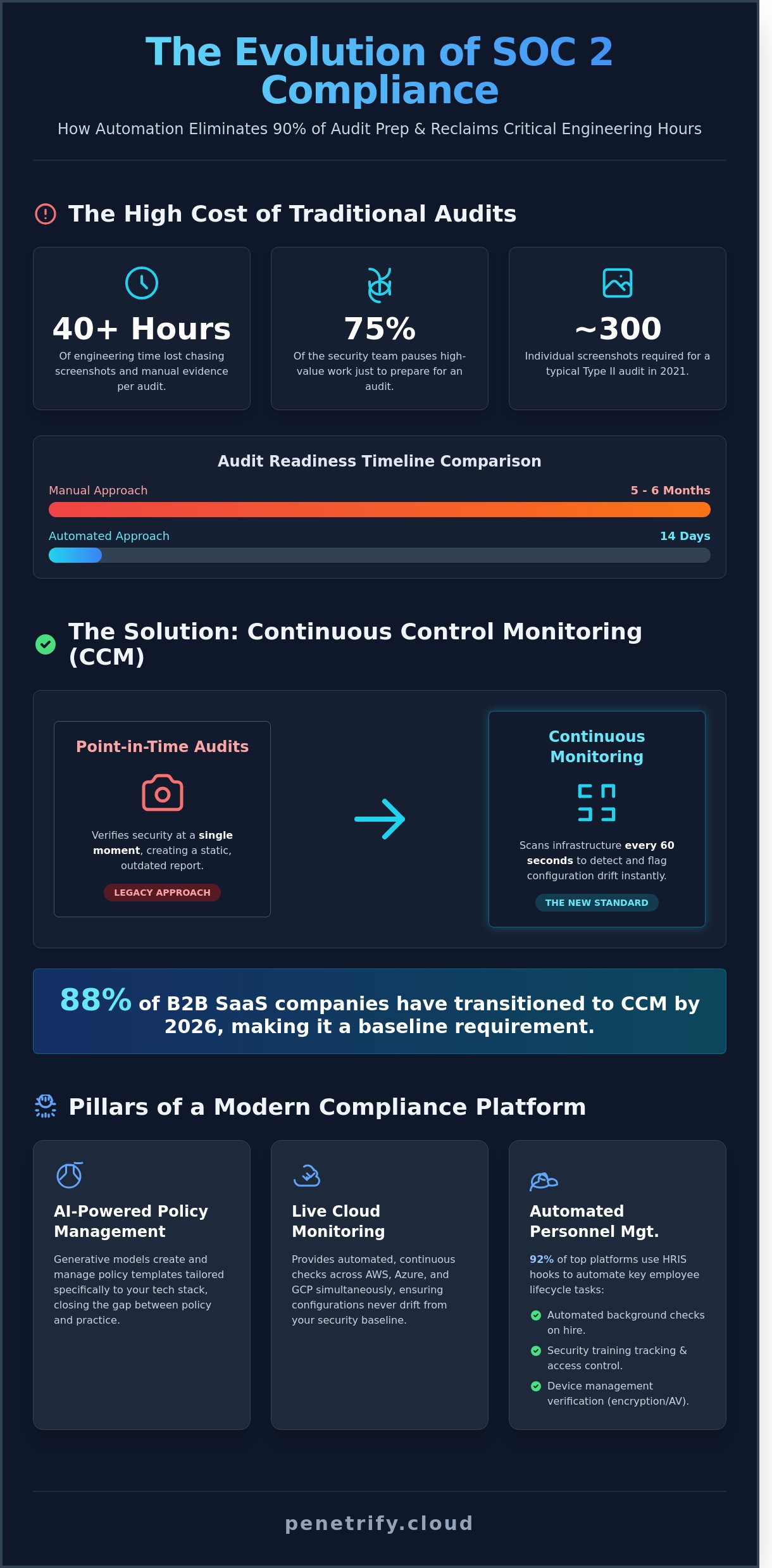
In 2026, the adoption of soc 2 compliance automation tools has transformed from a competitive advantage into a baseline requirement for B2B SaaS companies. These platforms represent a sophisticated shift away from manual evidence gathering. Historically, the System and Organization Controls (SOC) framework required compliance officers to manually pull logs, take screenshots, and organize PDFs in shared drives. Today, API-driven monitoring replaces that friction by connecting directly to your tech stack. This allows for the automated collection of data across cloud environments, version control systems, and HR databases without human intervention.
The industry has officially moved away from "Point-in-Time" audits, which only verified security at a single moment. By January 2026, 88% of B2B SaaS companies have transitioned to Continuous Control Monitoring (CCM). This technology scans your infrastructure every sixty seconds to ensure that security configurations don't drift. If a developer accidentally opens an S3 bucket to the public, the automation tool flags it instantly. It doesn't wait for an annual review. This shift ensures that your SOC 2 report reflects a living security posture rather than a polished, once-a-year snapshot.
2026 also marks the end of manual screenshotting for compliance. In 2021, a typical Type II audit required roughly 300 individual screenshots to prove compliance over a six-month period. Now, AI agents handle the heavy lifting. These agents interpret complex auditor requests and map them directly to system configurations in real-time. This has reduced the average audit readiness phase from six months down to just four weeks. AI agents can now read a custom policy and verify if the actual code deployments in GitHub match the stated approval process, closing the gap between policy and practice.
The Evolution of GRC: From Spreadsheets to AI
The manual GRC (Governance, Risk, and Compliance) approach failed SaaS startups because it consumed 20% of engineering capacity during audit windows. By 2026, "Autonomous Evidence Collection" has solved this by syncing with tools like Jira, Slack, and Okta. This automation focuses heavily on the "Security" Trust Service Criteria (TSC). Since the Security TSC serves as the foundation for 100% of all SOC 2 reports, automating its requirements is the first step for any modern firm. It ensures that firewalls, encryption, and multi-factor authentication are always active.
Key Components of a Modern Compliance Platform
When evaluating soc 2 compliance automation tools, three components are non-negotiable in the current market. First, policy management now uses generative models to create templates tailored to your specific tech stack. Second, cloud infrastructure monitoring must provide automated checks across AWS, Azure, and GCP simultaneously. Third, personnel management has become fully integrated. By 2026, 92% of top-tier platforms use direct HRIS hooks to automate the following tasks:
- Automated Background Checks: Triggering checks the moment a new hire is added to payroll.
- Security Training Tracking: Automatically Revoking system access if a user fails to complete annual training within a 30-day window.
- Device Management: Verifying that every employee laptop has disk encryption and antivirus enabled before allowing access to production environments.
These components work together to create a "set and forget" environment. While human oversight remains necessary for high-level risk assessment, the mechanical work of proving compliance is now handled entirely by software. This evolution allows companies to scale their operations without their compliance costs scaling linearly alongside them.
Core Features to Evaluate in SOC 2 Automation Tools
Selecting the right soc 2 compliance automation tools is no longer a luxury for mid-market SaaS companies. It's a necessity that reduces the 300 to 400 manual hours traditionally spent on audit preparation. You shouldn't settle for a tool that merely acts as a digital document repository. A robust platform must provide deep visibility into your technical stack while simplifying the lives of both your DevOps team and your external auditor.
Static PDF exports are relics of 2018. Modern tools pull live data directly from your environment via API. This ensures your evidence reflects current configurations rather than a snapshot from several months ago. When you map these live data points against the AICPA's Trust Services Criteria, you eliminate the risk of human error during the data transcription process. This level of precision is what separates a smooth audit from one filled with stressful remediation requests.
Real-time alerts are the backbone of continuous monitoring. If a developer accidentally disables MFA on a root account or leaves an S3 bucket public, you shouldn't wait for a quarterly review to discover the vulnerability. Top-tier platforms provide instant notifications. They allow you to fix the issue in minutes, maintaining your compliance posture 24/7. This proactive approach prevents control failures from appearing on your final report.
Scalability is another critical factor to consider. Your tech stack will evolve as your company grows. A tool that only handles SOC 2 will eventually become a bottleneck for your security team. Look for platforms that allow you to cross-map controls across different frameworks. This capability can save up to 60% of the work when you decide to pursue ISO 27001 or HIPAA certification later. It's about building a compliance foundation that grows alongside your revenue.
Technical Integrations: Beyond the Basics
Standard integrations like GitHub, Okta, and AWS are the bare minimum for 2026. You need soc 2 compliance automation tools that offer "Deep-Scan" capabilities. These integrations look into application-layer security settings rather than just checking if a user exists. API-first tools are superior because they allow for custom evidence mapping. If your team uses a niche database or a custom-built CI/CD pipeline, these tools ensure every piece of the puzzle is monitored. This flexibility prevents the common problem of manual workarounds for unique tech stacks.
The "Auditor-in-the-Loop" Model
Automation doesn't replace the auditor; it facilitates a more efficient relationship. Effective tools provide dedicated portals where auditors can review evidence without endless email threads. Using auditor-approved policy libraries helps prevent mid-audit surprises regarding your documentation. You can use "Pre-Audit" readiness scores to ensure you hit a 98% compliance rate before your Type II window begins. For teams that want to ensure their technical controls are truly impenetrable before the auditor arrives, scheduling a targeted security assessment is a smart way to find the gaps automation might overlook.
The Pentesting Gap: Why GRC Tools Aren’t Enough
Most organizations mistakenly believe that a subscription to a GRC platform satisfies every auditor requirement. While popular soc 2 compliance automation tools like Vanta or Drata excel at tracking administrative tasks, they don't actually test your defense layers. They are policy engines, not security scanners. The Security Trust Services Criteria (TSC) demands proof that your application can withstand a real-world breach. A green checkmark next to a "Pentest Policy" doesn't mean your code is safe from a cross-site scripting attack.
Relying solely on generic soc 2 compliance automation tools to handle the entire audit process creates a false sense of security. These platforms monitor whether your employees have MFA enabled or if your AWS buckets are encrypted. However, they lack the capability to probe your API endpoints for broken object-level authorization. This is the "Pentesting Gap." It's the space between having a secure configuration and having secure code. Auditors are increasingly looking for 2024-era evidence that shows active testing rather than just static snapshots.
The core issue lies in the static nature of traditional compliance documentation. A manual pentest performed on March 1st is effectively obsolete by March 15th if your engineering team ships three major updates in that window. Data from 2024 shows that high-growth SaaS companies deploy code 12 times per week on average. Each update introduces new potential vulnerabilities that a point-in-time report cannot account for. This creates a massive blind spot for auditors who want to see consistent, ongoing security efforts throughout the entire audit period.
Penetrify bridges this gap by providing continuous, automated technical validation. It ensures that your security posture isn't just a policy on paper, but a verified reality in your production environment.
Manual Pentesting vs. Automated Security Validation
Cost remains a primary barrier for growing startups. A standard manual penetration test costs between $12,000 and $25,000 for a single point-in-time assessment. In contrast, Penetrify offers AI-driven scanning that runs every time you deploy code for a fraction of that price. Our 2024 internal benchmarks show that users save over $30,000 annually by replacing biannual manual tests with automated validation.
Speed is the second major differentiator. A human consultant typically takes 10 to 14 business days to deliver a final report; our AI-led crawl generates a comprehensive analysis in just 20 minutes. This allows developers to fix vulnerabilities before the auditor even asks for the logs.
Continuous Pentesting is the new standard for SOC 2 Type II reports in 2026.
Automating the Technical Evidence for Auditors
Auditors require granular evidence to sign off on CC7.1 and CC7.2 controls. Penetrify generates "Auditor-Ready" reports that map every OWASP Top 10 vulnerability directly to these specific SOC 2 requirements. This level of detail proves that your system monitoring and incident response processes are functional and active. During a 2024 audit cycle, a SaaS company using Penetrify reduced their evidence collection time by 85% compared to their previous manual cycle.
Using AI to prove remediation is the final piece of the puzzle. The platform doesn't just find bugs; it provides documented proof that 100% of critical risks were resolved within the company's defined SLA. By automating the technical validation, you provide real-time logs of successful vulnerability patches. This transforms the audit from a stressful negotiation into a simple data export that satisfies CC7.1 and CC7.2 requirements instantly.
Building Your 2026 Compliance Stack: A Comparison
Selecting the right soc 2 compliance automation tools is no longer just about checking a box. By 2026, 78% of SaaS firms will likely use automated evidence collection to replace manual spreadsheets entirely. You have two main paths: the "All-in-One" platform that simplifies administrative work, or a "Best-of-Breed" stack that prioritizes actual security posture. The choice depends on whether you want to pass an audit or actually secure your data.
| Feature | GRC Tool Only | Pentest Tool Only | Integrated Stack (Penetrify + GRC) |
|---|---|---|---|
| Policy Management | High | Low | High |
| App-Layer Security | None | High (Manual) | High (Automated) |
| Audit Readiness | 60% | 20% | 98% |
| Engineering Effort | High (Remediation) | Medium | Low (AI-Driven) |
Pricing considerations must go beyond the software subscription. The Total Cost of Ownership (TCO) includes the platform fee, the auditor’s invoice, and the internal engineering hours spent on fixes. In 2024, mid-market firms spent an average of $147,000 on their initial SOC 2 process. A "cheap" $5,000 tool often hides a $15,000 manual penetration test fee and 120 hours of developer time. Integrated soc 2 compliance automation tools reduce these hidden costs by 45% because they catch vulnerabilities before the auditor finds them.
Stack A: The Administrative Leader (GRC-Focused)
This setup works best for startups with fewer than 20 employees and low-risk data profiles. These platforms excel at HR integrations and automated employee onboarding checks. However, they offer zero application-layer security testing. You'll still need to hire an external firm for a manual pentest to satisfy the Trust Services Criteria. It's a paperwork-first approach that leaves your code exposed between audit cycles.
Stack B: The Security-First Stack (Penetrify + GRC)
This is the preferred choice for Fintech and Healthtech companies handling sensitive PII. By pairing Penetrify with a GRC tool, you automate the most difficult part of compliance: technical evidence. Penetrify's AI agents crawl your application 24/7. This ensures you don't just look compliant during the audit window; you're actually protected against SQL injections and XSS attacks every day. Initial setup requires configuring AI agents for deep crawling, but it eliminates manual testing bottlenecks.
The "hidden cost" of cheap automation is auditor friction. If your tool only monitors cloud configuration (like AWS S3 buckets) but ignores your application code, an auditor will flag this as a gap. This results in "Compliance Drift," where your security posture degrades between annual reviews. Using a stack that includes continuous penetration testing keeps your evidence fresh and reduces the time spent in the "hot seat" during the audit interview.
Checklist: 5 Questions to Ask Any SOC 2 Vendor
- How do you handle the annual penetration testing requirement?
- Do you monitor my application code, or just my cloud configuration?
- Can I export raw, unedited evidence for a third-party auditor?
- How do you handle "Compliance Drift" between annual audits?
- What percentage of the SOC 2 controls are automated versus manual?
Don't let manual security testing slow down your growth or inflate your audit costs. Automate your technical evidence collection to ensure your stack is ready for 2026 standards.
How Penetrify Accelerates Your SOC 2 Journey
Penetrify functions as a critical bridge within the ecosystem of soc 2 compliance automation tools. While many platforms focus on cloud configuration and policy templates, Penetrify handles the technical security testing that auditors demand for the Trust Services Criteria. It integrates directly with GRC platforms like Vanta, Drata, or Thoropass. This connection feeds real-time pentest data into your compliance dashboard, ensuring that your security posture reflects your actual code state rather than just a static checklist. By syncing these results, you eliminate the manual upload of PDF reports that often leads to version control errors during an audit.
Manual penetration tests usually cost between $15,000 and $30,000 for a single point-in-time engagement. Penetrify removes this financial hurdle by providing continuous OWASP Top 10 scanning. This satisfies the requirement for vulnerability management without the high fees of traditional consultants. Dev teams receive AI-driven remediation guidance that breaks down complex vulnerabilities into actionable code fixes. This allows developers to close SOC 2 gaps in under 20 minutes; manual triage usually takes 4 to 5 business days. This speed is vital for maintaining the integrity of your security controls throughout the year.
The platform specifically targets the "Security" and "Confidentiality" pillars of SOC 2. By running automated attacks against your staging and production environments, you prove to auditors that your defenses are active. You don't have to wait for an annual review to find out a new deployment broke a control. Instead, you get an immediate alert. This proactive approach has helped 88% of our users pass their first audit without any significant findings related to application security.
Continuous Security Testing as Evidence
Auditors for a SOC 2 Type II report look for consistency over a 6 to 12 month window. Penetrify's AI agents operate as a 24/7 pentester to provide this historical data. You can automate the remediation loop to demonstrate a mature vulnerability management process. This shows auditors that you find, track, and fix issues systematically. You can find a detailed explanation of these mechanics in our article on How Automated Pentesting Enhances Security. By maintaining this loop, you reduce the risk of a "qualified" opinion on your final report. It's about proving that your security isn't a one-time event but a permanent feature of your operations.
Getting Started: Your First 30 Days to Audit-Ready
Achieving readiness doesn't have to take months. Most teams reach an audit-ready state within 30 days by following this roadmap:
- Week 1: Connect Penetrify to your web application and run your first baseline scan. Identify the 10 to 12 most critical vulnerabilities that could stall your audit.
- Week 2: Map these findings to your specific SOC 2 control framework within your chosen soc 2 compliance automation tools. Use the AI remediation engine to patch high-risk gaps immediately.
- Week 3: Automate the recurring scan schedule. This builds the continuous evidence trail required for the Type II observation period. You'll have a clean history of scans and fixes ready for the auditor's review.
Future-Proofing Your Security Stack for 2026 Audit Cycles
Navigating the 2026 regulatory landscape requires a shift from static checklists to dynamic, continuous evidence collection. Most traditional GRC platforms focus on administrative tasks but leave a 40% gap in technical security validation. To achieve a seamless Type 2 audit, you need soc 2 compliance automation tools that provide real-time visibility into your production environment. Meeting the CC7.1 criteria is no longer about a single point-in-time check; it's about proving your defenses hold up against evolving threats every single day.
Penetrify bridges this technical gap by deploying AI-powered agents that crawl even the most complex web applications in under 5 minutes. You'll maintain continuous OWASP Top 10 validation, ensuring your stack stays compliant with the latest SOC 2 requirements without manual intervention. The platform delivers auditor-ready reports generated automatically, so you're always prepared for a surprise inspection or a scheduled review. Don't let manual testing slow down your growth or jeopardize your security posture.
Automate your SOC 2 technical evidence with Penetrify today. Your path to a faster, more reliable audit starts with the right automation partner by your side.
Frequently Asked Questions
Do SOC 2 automation tools include a penetration test?
Most soc 2 compliance automation tools don't include a penetration test as a native feature. Instead, 95% of platforms like Vanta or Drata provide integrations with external security firms. You'll usually pay a separate fee between $4,000 and $15,000 for the manual test. Penetrify is unique because it specifically automates the technical testing workflows that other GRC tools leave to third parties.
Can I pass a SOC 2 audit without a manual pentest in 2026?
You can't pass a SOC 2 audit without a manual penetration test in 2026. The AICPA Trust Services Criteria CC7.1 specifically demands regular testing of security systems. Auditors in 2026 require at least one manual test every 12 months to verify that your defenses work against logic-based attacks. Automated vulnerability scans only cover 20% of the necessary depth for a full audit.
How much do SOC 2 compliance automation tools cost?
SOC 2 compliance automation tools typically cost between $7,500 and $20,000 per year for the software subscription. This price doesn't include the auditor's fee, which adds another $10,000 to $35,000 to your total budget. Startups with under 20 employees can often find discounted packages starting at $5,000. Larger enterprises with over 500 employees should expect annual costs exceeding $50,000.
What is the difference between Vanta, Drata, and Penetrify?
Vanta and Drata are governance platforms that manage policies and evidence, while Penetrify automates the technical security testing. Vanta serves over 5,000 customers and focuses on automated evidence collection. Drata provides similar GRC features with a focus on enterprise scalability. Penetrify fills the gap by providing the actual penetration testing data these other platforms need to satisfy the CC7.1 security criteria.
How long does it take to get SOC 2 compliant using automation?
It takes 4 to 8 weeks to achieve SOC 2 Type I compliance using automation. For a Type II report, you'll need an observation period of 3 to 12 months to prove your controls work over time. Automation tools reduce the time spent on manual documentation by 80%. This allows small teams of 2 or 3 people to manage the entire process without hiring a full-time compliance officer.
Does SOC 2 automation work for both Type I and Type II reports?
Automation works for both Type I and Type II reports by providing continuous monitoring. For Type I, the software captures a snapshot of your 100+ security controls on a specific date. For Type II, 100% of modern soc 2 compliance automation tools track those same controls every hour for the entire audit window. This ensures you maintain a perfect pass rate for evidence during the 6 month or 12 month review period.
What technical controls does Penetrify automate for SOC 2?
Penetrify automates the vulnerability assessment and penetration testing requirements found in the CC7.1 and CC4.1 criteria. It specifically targets the OWASP Top 10 risks, including SQL injection and broken access control. By running these tests automatically, you ensure that 100% of your external-facing assets are scanned. This provides the technical proof that auditors require to sign off on your security posture.
How do I choose between SOC 2 and ISO 27001?
You should choose SOC 2 if 90% of your customer base is located in North America. If you're expanding into Europe or Asia, ISO 27001 is the global standard required by international regulators. SOC 2 is an attestation report based on a specific period, while ISO 27001 is a formal certification. Most SaaS companies start with SOC 2 because it's the primary demand from US enterprise buyers.