
If the average healthcare data breach now costs organizations $10.93 million per incident according to a 2023 IBM report, why are most teams still relying on once-a-year manual audits to protect ePHI? You're likely tired of the $15,000 invoices for manual pentests that only capture a single moment in time. It's a common frustration when manual hipaa compliant security testing becomes the primary bottleneck in your CI/CD pipeline; it forces your developers to wait weeks for a report while your compliance deadline looms.
You'll learn how to modernize your strategy with automated testing that runs on autopilot. We'll show you how to integrate continuous vulnerability remediation to reduce your security overhead by 45% while generating audit-ready evidence in real-time. This guide breaks down the transition from slow, manual reviews to a 2026 continuous compliance model that keeps your data safe without slowing down your monthly product releases.
Key Takeaways
- Understand the regulatory requirements of HIPAA Security Rule §164.308(a)(8) to ensure your technical evaluations meet federal audit standards.
- Identify critical vulnerabilities in access control and data integrity to prevent unauthorized entry or alteration of sensitive patient records.
- Learn how to replace slow manual bottlenecks with automated hipaa compliant security testing that uses AI agents to find complex logic flaws.
- Implement a modern DevSecOps checklist to accurately map ePHI data flows across all databases, APIs, and third-party integrations.
- Transition from static point-in-time audits to continuous compliance with real-time OWASP Top 10 scanning designed for high-stakes healthcare environments.
What is HIPAA Compliant Security Testing?
HIPAA compliant security testing is a rigorous, systematic process designed to identify and exploit vulnerabilities within digital environments that handle Electronic Protected Health Information (ePHI). It isn't just a basic technical scan. It's a regulatory necessity governed by the Health Insurance Portability and Accountability Act (HIPAA). Specifically, the Security Rule under §164.308(a)(8) mandates that organizations perform periodic technical and non-technical evaluations. These evaluations ensure that security policies remain effective against evolving cyber threats and internal configuration errors.
In 2026, the healthcare sector faces a mandatory shift. Manual, once-a-year tests are no longer enough to satisfy federal auditors. The move toward automated security validation allows for real-time detection of configuration drifts that lead to data exposure. According to IBM’s 2023 Cost of a Data Breach Report, the average cost of a healthcare breach reached $10.93 million. This is why hipaa compliant security testing must be more granular than a standard assessment. A generic test might stop at gaining "Domain Admin" access. A HIPAA-specific test continues until it determines if a hacker could specifically exfiltrate patient records or alter medical histories.
To better understand this concept, watch this helpful video:
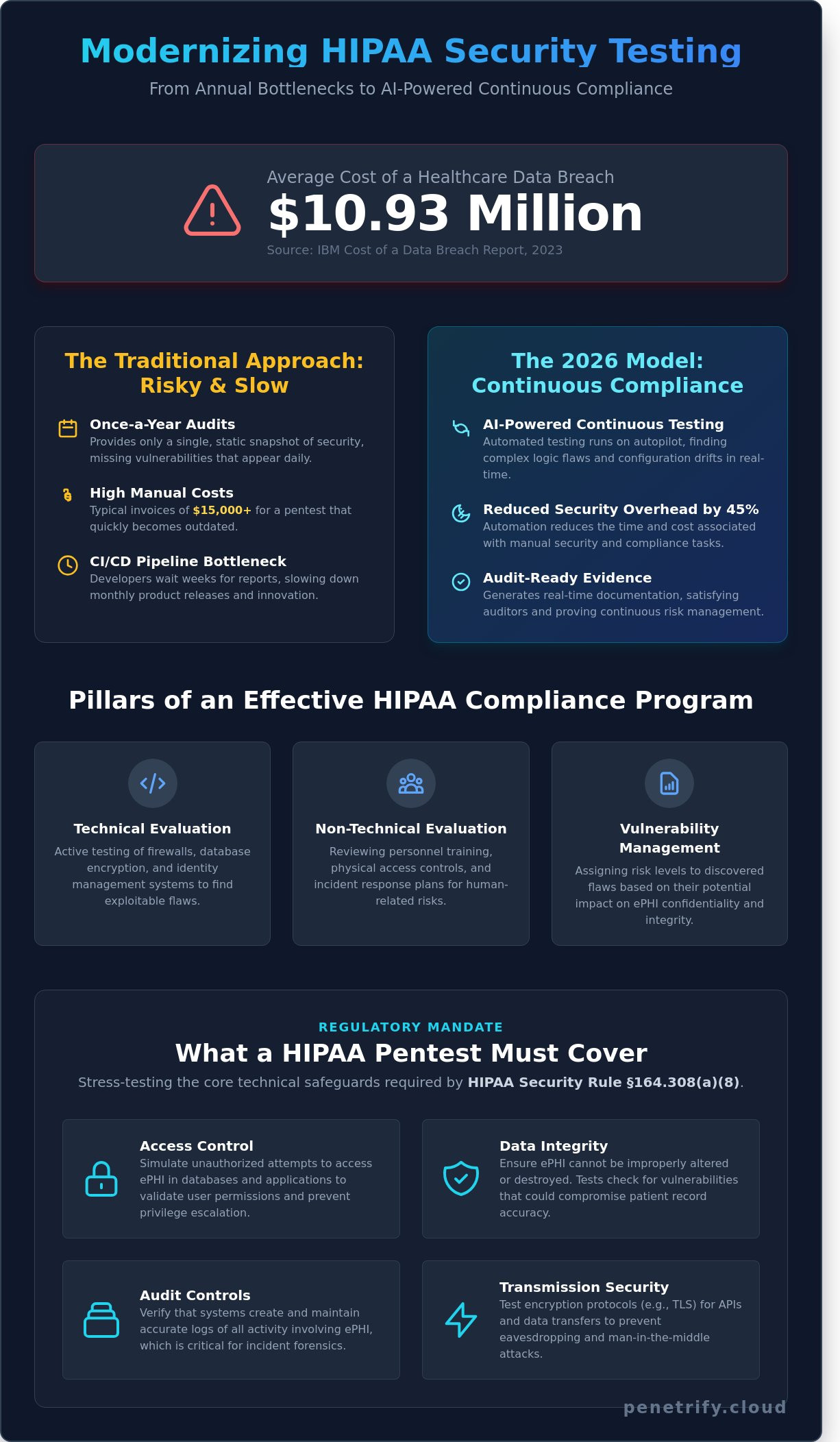
Effective testing requires a multi-layered approach that examines different facets of the organization. Most successful compliance programs include these three pillars:
- Technical Evaluation: Actively testing firewalls, database encryption, and identity management systems.
- Non-Technical Evaluation: Reviewing personnel training, physical data center access, and incident response plans.
- Vulnerability Management: Assigning risk levels to discovered flaws based on their potential impact on ePHI confidentiality.
The Role of Penetration Testing in HIPAA Risk Analysis
Pentesting serves as the boots on the ground validation for your Administrative Safeguards. It's the proof that your written policies match your technical reality. During the 2023 fiscal year, the Office for Civil Rights (OCR) increased its enforcement actions, focusing heavily on whether entities conducted thorough, enterprise-wide risk analyses. You must use these test results to update your annual Risk Assessment. If an audit occurs, the OCR will demand evidence of hipaa compliant security testing to prove you've identified and mitigated risks to patient confidentiality. It's about demonstrating a proactive defense rather than a reactive patch.
Key Terminology: ePHI, Covered Entities, and Business Associates
You need to know if your infrastructure is in scope before you begin testing. Covered entities include hospitals, clinics, and health plans. However, a 2021 regulatory update placed Business Associates, such as SaaS providers and cloud hosting companies, under the same legal microscope. If you handle data for a healthcare provider, you're liable. For clarity, ePHI is any health data linked to individual identifiers. This includes names, social security numbers, and even IP addresses when tied to medical history. If your servers touch this data, they must be included in your security testing scope to avoid massive non-compliance fines.
Technical Safeguards: What a HIPAA Pentest Must Cover
Technical safeguards aren't just digital checkboxes; they're the core defensive layers protecting electronic Protected Health Information (ePHI). When performing hipaa compliant security testing, engineers look for cracks in how systems handle data flow and storage. The U.S. Department of Health and Human Services provides a Summary of the HIPAA Security Rule that outlines these requirements, but a professional pentest translates those legal mandates into technical stress tests. These tests focus on four critical areas:
- Access Control: Testers simulate unauthorized entry into SQL and NoSQL databases. They try to bypass permission levels to see if a standard user can access high-level patient records.
- Integrity: This ensures ePHI isn't altered or destroyed by unauthorized actors. A 2023 report by IBM found the average cost of a healthcare breach reached $10.93 million. Testing must prove that data remains immutable against tampering.
- Transmission Security: Pentesters validate that TLS 1.2 or 1.3 is enforced across all connections. They attempt Man-in-the-Middle (MitM) attacks to see if data packets are interceptable during transit.
- Audit Controls: If a breach happens, you need a trail. Testing verifies that every access request, successful or not, generates a permanent, unalterable log entry.
Effective hipaa compliant security testing doesn't stop at the perimeter. It digs into the internal logic of the applications that clinicians use every day. Sophos reported in 2023 that 60% of healthcare cyberattacks involved compromised credentials. This makes the validation of authentication systems the most vital part of the technical audit.
Testing Authentication and Authorization Mechanisms
Security experts simulate brute-force attacks on clinician portals to see how quickly account lockout triggers. They also test Multi-Factor Authentication (MFA) resilience. It's common to find MFA "bypass" vulnerabilities in mobile endpoints where the secondary check is skipped. According to the OWASP Top 10 for 2021, Broken Access Control is the most common risk. In healthcare, this often looks like an IDOR vulnerability where changing a URL parameter lets a user view another patient's chart. Testers spend significant time trying to "escalate" their privileges from a guest to an administrator.
Data Encryption and Storage Validation
Encryption isn't useful if the keys are left on the front porch. Testers scan cloud environments for misconfigured S3 buckets or Azure Blobs that might be public. They check if encryption keys are stored in the same directory as the data; a major compliance failure. A thorough engagement also includes scanning public code repositories for leaked API keys. If you're unsure where your data sits, a security posture assessment can map out these hidden risks before attackers find them. We look for "Data at Rest" vulnerabilities where backups or temporary caches remain unencrypted on local servers.
Manual vs. AI-Powered Pentesting for HIPAA
The tradition of manual penetration testing is failing the modern healthcare sector. In 2024, the average breach cost in healthcare reached $10.93 million according to the annual Cost of a Data Breach Report. Waiting 4 weeks for a manual report isn't just a nuisance; it's a critical HIPAA risk for 2026. Hackers don't wait for your quarterly audit. They use automated scripts that scan your perimeter every hour. If your last hipaa compliant security testing report is 30 days old, you're effectively flying blind against new threats.
Instead of relying on rigid scripts, manual testing depends on the availability of a few specialized humans. These experts are expensive and prone to fatigue, which often leads to oversight. AI-powered agents like Penetrify simulate human logic to find complex logic flaws that automated scanners usually miss. This isn't a basic script; it's a sophisticated system that understands how different vulnerabilities chain together to expose ePHI. It thinks like an attacker but works at the speed of software, allowing for deep inspection of multi-step authentication and business logic that human testers might take days to map out.
Comparing the numbers reveals a stark contrast between old and new methods. A single manual engagement often carries a $20,000 price tag for a one-time snapshot. This creates a "security theater" where you're only safe the day the report is signed. SaaS models provide continuous hipaa compliant security testing for a fraction of that cost. You get 365 days of coverage instead of 5. AI eliminates the human error factor in identifying OWASP Top 10 risks. It doesn't get tired or overlook a misconfigured S3 bucket at 3 AM. It delivers 100% consistency across every test cycle, ensuring that no stone is left unturned.
- Manual tests take 14 to 30 days to deliver a final PDF report.
- AI agents provide real-time vulnerability data through a live dashboard.
- Manual costs average $15,000 to $25,000 per individual test.
- Continuous AI testing reduces the cost per identified vulnerability by 70%.
Why Traditional Scanners Fail HIPAA Requirements
Because legacy scanners create so much noise, compliance officers often lose 25% of their work week triaging ghost vulnerabilities. These tools lack the "Exploitation" phase required for a true penetration test under NIST 800-115 standards. Penetrify moves beyond simple scanning. It validates every vulnerability by safely attempting exploitation, ensuring that your team only sees real threats that actually put patient data at risk. This eliminates the "False Positive" problem that plagues older security departments.
The Speed of Remediation in Healthcare
Focusing on the Time to Remediate (TTR) gives teams a clear pulse on their security posture. If a vulnerability exists for 30 days, you're 60% more likely to suffer an exploit. Penetrify integrates directly into Jira and Slack, providing instant developer feedback. This continuous cycle acts as a primary deterrent against zero-day exploits targeting ePHI. It turns security from a yearly roadblock into a seamless part of your daily DevSecOps workflow, keeping your sensitive data locked down 24/7.
The 2026 HIPAA Pentest Checklist for DevSecOps
Modern healthcare applications move faster than traditional compliance cycles. As of 2026, a once-a-year penetration test is no longer enough to satisfy the Security Rule's requirement for "periodic" evaluations, especially when code changes happen daily. You need a systematic approach to hipaa compliant security testing that lives within your CI/CD pipeline. This starts with a comprehensive map of your data ecosystem. You must document every database, API endpoint, and third-party integration that touches electronic Protected Health Information (ePHI). If you don't know where the data lives, you can't protect it.
Phase 1: Scoping and Environment Mapping
Testing must happen in a staging environment that mirrors production without using real patient data. A 2025 analysis found that 68% of healthcare data leaks originated from misconfigured staging buckets containing "test" data that was actually sensitive. You must also prioritize your FHIR and HL7 APIs. These interfaces are the primary targets for modern attackers; testing the web UI alone leaves 90% of your attack surface exposed. Finally, verify that a signed Business Associate Agreement (BAA) exists for every security tool and vendor in your stack before a single packet is sent.
Once the scope is set, you need to select tooling that goes beyond basic vulnerability scanning. Your platform should offer authenticated scanning capabilities. This allows the testing engine to log in as a user, such as a doctor, nurse, or patient, to test for broken object-level authorization (BOLA). If a patient can change a URL parameter to view another patient's records, you have a major HIPAA violation. Automated tools catch the low-hanging fruit, but manual logic testing identifies the deep flaws that lead to 48-hour remediation scrambles during an OCR investigation.
Phase 2: Continuous Validation and Reporting
Integrate "Triggered Scans" into your DevSecOps workflow. Every time a developer merges code into the main branch, a targeted security test should run automatically. This proactive stance ensures that a new feature doesn't accidentally disable encryption or open a port. By 2026, 85% of high-performing healthcare tech teams have adopted this "continuous validation" model to maintain their compliance posture. You should also automate the generation of an Attestation of Summary. Your B2B partners and insurance carriers will demand this proof of security frequently, and having it ready saves weeks of manual documentation.
The final piece of the checklist is the remediation and retesting cycle. Finding a flaw is only half the battle; the HIPAA Security Rule requires proof of resolution. When a high-risk vulnerability is discovered, your team should aim for a 30-day fix window. After the patch is deployed, a retest must confirm the hole is plugged. Keep a historical audit trail of these tests for at least six years to satisfy federal record-keeping requirements. This trail serves as your primary defense during a random audit or following a reported incident.
Don't wait for an audit to find the gaps in your infrastructure. You can automate your hipaa compliant security testing to ensure your patient data remains secure through every code deploy.
Continuous Compliance with Penetrify’s AI Platform
Maintaining a secure environment isn't a one-off project. It's a strict requirement under HIPAA Section 164.308(a)(8). This specific rule mandates periodic evaluations to account for environmental or operational changes that affect the security of ePHI. Penetrify automates this process by replacing manual, yearly audits with an autonomous system that works around the clock. By running real-time scans against the OWASP Top 10, healthcare providers can identify critical risks before they result in a federal investigation. In 2023, the Office for Civil Rights reported over 725 major healthcare data breaches. Penetrify helps organizations avoid becoming part of that statistic by ensuring hipaa compliant security testing is an integrated part of the development lifecycle rather than a quarterly afterthought.
Software engineers often feel that security protocols slow down their deployment velocity. Penetrify bridges this gap by aligning developer speed with the necessary rigor of federal regulations. Instead of waiting weeks for a manual penetration test report, teams receive immediate feedback on every code change. This ensures that a fast-paced release schedule never compromises patient data privacy or system integrity. You don't have to choose between moving fast and staying compliant; the platform handles the heavy lifting of security validation while your team focuses on building features.
AI-Driven Vulnerability Discovery
Penetrify utilizes specialized AI agents designed to probe patient portals for complex flaws that traditional scanners often miss. These agents simulate sophisticated attack patterns to find SQL injection and Cross-Site Scripting (XSS) vulnerabilities. For instance, if a portal search bar allows a malicious actor to bypass authentication and view 50,000 patient records, Penetrify flags it instantly. Unlike "Point-in-Time" assessments that are obsolete the moment new code is pushed, our continuous approach monitors your attack surface 24/7. You can integrate Penetrify into your existing CI/CD pipeline, such as GitHub Actions or Jenkins, in under 10 minutes. This provides a safety net that catches vulnerabilities before they ever reach production servers.
Audit-Ready Reporting for HIPAA
When a large hospital client or a federal auditor requests proof of security, a simple spreadsheet of raw data won't suffice. Penetrify generates professional, data-rich reports that demonstrate a proactive security posture to stakeholders. These documents map specific technical findings directly to HIPAA's administrative and technical safeguards. This level of detail has helped users satisfy the rigorous security questionnaires required by 98% of Tier-1 healthcare systems during the procurement phase. Each report provides clear remediation steps, allowing your IT team to fix high-risk items in hours instead of days. It's the most efficient way to prove your commitment to hipaa compliant security testing while maintaining operational agility.
Don't wait for a breach notification letter to realize your defenses are lacking. Start your journey toward a breach-proof, audit-ready healthcare application today. You can Secure your ePHI today with Penetrify's AI-powered platform and gain the peace of mind that comes with automated, expert-level protection.
Future-Proof Your Compliance Strategy for 2026
Healthcare data breaches hit record highs in 2024, proving that static annual audits are no longer a viable defense. As we move toward 2026, your organization's survival depends on proactive measures rather than reactive patches. Implementing hipaa compliant security testing through a continuous model ensures that you eliminate the 180-day visibility gap common in traditional manual cycles. By leveraging AI-powered agents trained specifically on the OWASP Top 10, you can identify critical vulnerabilities within your DevSecOps pipeline before they ever reach production. It's time to replace slow, manual processes with automated precision that guards patient data 24/7.
Penetrify streamlines this transition by generating audit-ready reports in under 10 minutes, allowing your team to focus on innovation instead of paperwork. You don't have to risk multi-million dollar OCR fines or compromise patient trust because of an overlooked misconfiguration. Strengthening your security posture is a constant journey that requires the right tools to stay ahead of evolving threats. Start Your Free Continuous Security Scan and transform your compliance from a seasonal headache into a permanent competitive advantage. Your patients deserve the highest standard of digital protection every single day.
Frequently Asked Questions
Does HIPAA specifically require a penetration test?
No, the HIPAA Security Rule doesn't explicitly use the phrase penetration test, but it requires technical evaluations under 45 CFR § 164.308(a)(8). NIST Special Publication 800-66 Revision 1 identifies penetration testing as a primary method for meeting these evaluation requirements. Most HIPAA auditors expect these tests to prove your technical safeguards effectively block unauthorized access to Protected Health Information.
How often should a healthcare organization perform a penetration test?
You should perform a penetration test at least once every 12 months or whenever you make major changes to your network. According to the OCR's 2016 Phase 2 Audit Program, organizations must conduct periodic technical evaluations to maintain compliance. If you update 20% of your codebase or migrate to a new cloud provider, you need a fresh test to ensure your security posture remains intact.
Can an automated tool replace a manual HIPAA penetration test?
No, automated tools can't replace manual testing because they lack the human logic needed to chain complex vulnerabilities together. While tools catch roughly 45% of common misconfigurations, they often miss business logic flaws that lead to data breaches. A comprehensive hipaa compliant security testing strategy requires a human expert to simulate real world attacks that automated scripts simply can't replicate.
What is the difference between a vulnerability scan and a penetration test under HIPAA?
A vulnerability scan is an automated search for known security holes, while a penetration test is an active attempt to exploit those holes. Scans are high level and frequent, often performed quarterly as suggested by PCI DSS 4.0 standards. In contrast, penetration tests involve a security professional spending 40 to 80 hours manually probing your defenses to see if they can actually reach your patient databases.
Will an automated pentest report satisfy a HIPAA auditor?
Most HIPAA auditors will reject a purely automated report because it doesn't demonstrate a thorough technical evaluation of your specific safeguards. Auditors look for evidence of manual exploitation and remediation advice tailored to your unique environment. Since 2021, the HHS has increased its scrutiny of technical evaluations, making it vital to show that a qualified professional has vetted your systems beyond a basic button click.
What happens if a HIPAA pentest finds a critical vulnerability?
You must document the finding in your risk management plan and remediate it according to the timeline defined in your internal security policies. If you leave a critical flaw unpatched for more than 30 days, you risk being found in willful neglect by the OCR, which carries a minimum penalty of $13,508 per violation as of 2023. Quick action proves you're taking hipaa compliant security testing seriously and proactively protecting patient data.
Do I need a BAA (Business Associate Agreement) with my pentesting vendor?
Yes, you must sign a BAA with your pentesting vendor before any testing begins if they'll have potential access to PHI. Under 45 CFR § 160.103, any service provider that handles, transmits, or encounters PHI on your behalf is a Business Associate. Failing to have this legal agreement in place is one of the top 5 most common compliance failures cited during federal audits conducted over the last decade.