

What if your next security audit could identify critical vulnerabilities in 15 minutes instead of the 14 days it typically takes a manual firm to deliver a report? Security teams often face a backlog of 500 or more unpatched vulnerabilities while waiting for human testers to clear their schedules. You're likely asking, how does AI penetration testing work to solve this bottleneck without losing the creative logic of a human hacker? It's not a basic scanner; it's an autonomous engine that maps complex attack paths in real time.
You've probably felt the frustration of a CI/CD pipeline stalling because a legacy tool flagged 40 false positives that your developers had to manually investigate. It's a constant struggle to maintain speed while ensuring your perimeter is actually secure. This article breaks down the reasoning engines and automated workflows that allow AI to simulate sophisticated attackers at scale. You'll gain a clear understanding of the underlying architecture and learn how to integrate these autonomous tools into your workflow for continuous, reliable protection.
Key Takeaways
- Learn the fundamental difference between testing AI models and using autonomous agents to automate security assessments through heuristic-based logic.
- Discover how does AI penetration testing work by exploring the reasoning engines that allow autonomous agents to map architectures and select optimal attack payloads.
- Compare the speed and frequency of on-demand AI testing against traditional manual methods to identify where machine logic outperforms human intuition.
- Master the full lifecycle of an autonomous pentest, from initial target scoping and reconnaissance to automated vulnerability remediation.
- Understand how to integrate continuous security into your development pipeline to catch critical application security risks before they ever reach production.
Defining AI Penetration Testing: The Two Sides of Modern Security
Understanding the evolution of digital security requires a clear look at two distinct branches. First, there is the security of AI models themselves, specifically protecting Large Language Models from manipulation. Second, there is the use of AI as an autonomous tool to secure external systems. To grasp how does AI penetration testing work, you have to see it as a move away from simple signature-based scanners. Unlike a traditional penetration test that relies on point-in-time human intervention, AI systems use heuristic-based autonomous testing to think like an attacker. They don't just follow a checklist; they adapt to the environment they encounter.
To better understand this concept, watch this helpful video:
Traditional Dynamic Application Security Testing (DAST) often fails when facing modern web architectures. These legacy tools struggle with complex logic and frequently return false positives. Intelligent agents solve this by simulating real-world cyberattacks through multi-step reasoning. They identify a potential entry point, verify its validity, and attempt exploitation just as a human hacker would. This shift allows security teams to focus on remediation rather than sorting through thousands of irrelevant alerts.
The Core Definition
AI penetration testing is an autonomous system that uses machine learning to discover, verify, and exploit vulnerabilities. It marks a departure from passive scanning. While older tools stop after identifying a potential bug, AI-driven systems move into active exploitation to prove the risk exists. This capability enables a continuous security posture. Organizations no longer have to wait for an annual audit; instead, they run 24/7 simulations that evolve alongside their code updates.
Why 2026 is the Year of AI Pentesting
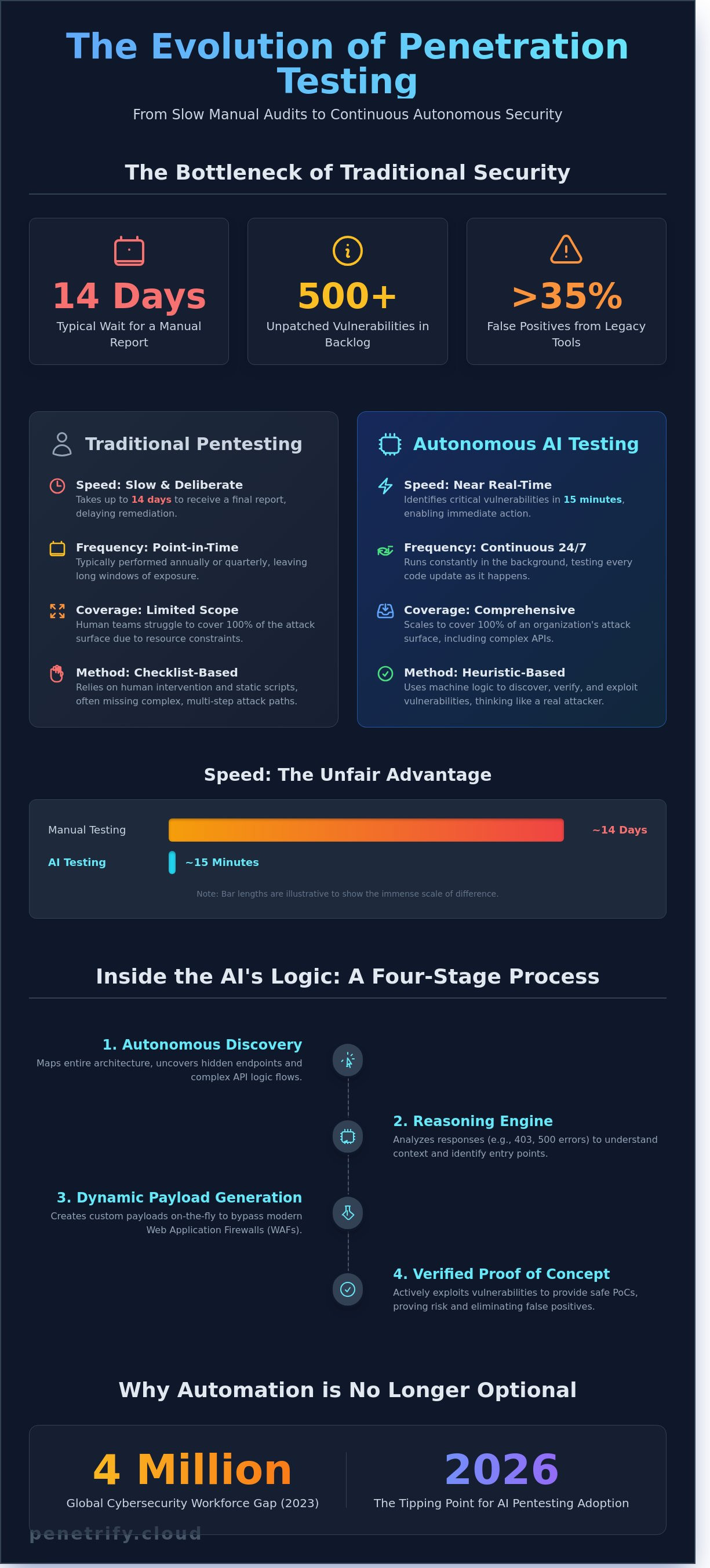
The global cybersecurity workforce gap reached 4 million professionals in 2023 according to ISC2 data. This shortage makes manual testing impossible to scale. By 2026, the explosion of rapid software deployment cycles will require automation that can handle JavaScript-heavy applications and complex APIs. AI agents are the only solution capable of processing these high-speed environments. They provide the scalability needed to cover 100% of an organization's attack surface, a feat that 73% of companies currently struggle to achieve with human teams alone.
The Mechanics of Machine Logic: How AI Agents Simulate Attackers
Understanding how does AI penetration testing work requires looking at the transition from "dumb" automation to cognitive reasoning. Unlike traditional scanners that follow a predefined list of URLs, AI agents perform autonomous discovery. They map an entire application architecture by identifying hidden endpoints and logical flows that human testers often miss. This isn't just a crawler hitting links; it's a system that understands the relationship between different API calls and data structures.
The reasoning engine serves as the brain of the operation. When an agent receives a 403 Forbidden or a 500 Internal Server Error, it doesn't stop. It analyzes the headers and body content to determine if the response indicates a misconfiguration or a potential entry point. Using machine learning, these agents generate custom payloads designed to bypass modern Web Application Firewalls (WAFs). Recent research into AI-driven penetration testing shows that integrating Large Language Models (LLMs) with frameworks like Metasploit allows for the automation of complex exploit selection. By tweaking characters and encoding on the fly, AI reduces the 35% false positive rate common in legacy tools. It proves the flaw by generating a safe Proof of Concept (PoC) rather than just flagging a suspicious string.
From Static Scripts to Autonomous Agents
Legacy automation follows a fixed path. If a button isn't in the script, the tool misses it. AI logic adapts to the environment. It uses feedback loops to refine its strategy in real-time. Natural Language Processing (NLP) plays a critical role here. It allows the agent to understand the context of a page. It can distinguish a "Password Reset" flow from a "User Profile" update and adjust its attack vector accordingly. This context-awareness ensures the agent doesn't waste time on irrelevant fields.
Handling Complex Vulnerabilities
AI approaches SQL Injection (SQLi) by testing different database dialects like PostgreSQL or MySQL based on subtle timing differences in server responses. For Cross-Site Scripting (XSS) in single-page applications (SPAs), the agent interacts with the DOM to see how data renders. When testing Broken Access Control, the AI maps user roles. It attempts to access administrative functions from a guest session to identify logic flaws. If you want to see these agents in action, you can explore automated security scanning to identify these gaps before attackers do. These systems now handle 90% of the reconnaissance work that used to take human testers several days to complete.
AI-Driven vs. Traditional Manual Pentesting: Breaking the Speed Barrier
Traditional manual testing often feels like a bottleneck in modern development. You schedule it 3 weeks out; the consultant spends 5 days on site; you wait another 10 days for a static PDF report. Understanding how does AI penetration testing work involves looking at its ability to execute thousands of payloads per second. While a human tester might manually check 50 endpoints in a day, an AI agent can scan 500 microservices simultaneously. This removes the "security tax" on innovation, allowing developers to move fast without breaking their safety protocols.
The Speed Advantage
Speed is the most visible differentiator. A 2023 industry benchmark showed that manual penetration tests take an average of 14 days from kickoff to final report. In contrast, AI-driven platforms deliver initial findings in under 25 minutes. This is critical because code changes occur daily. Relying on a point-in-time test performed once a year leaves a 364-day window of vulnerability. AI enables continuous testing within the CI/CD pipeline, catching bugs before they reach production. According to recent insights on generative AI in cybersecurity, professionals are using these tools to simulate attacks at a scale humans cannot match. This allows for parallel testing across hundreds of microservices without adding headcount.
The financial gap is equally wide. A single manual engagement costs between $15,000 and $45,000 depending on the scope. AI models typically operate on a flat-rate SaaS subscription, often costing less than $2,500 per month for unlimited scans. This shift allows teams to "Shift Left," integrating security checks into every build rather than treating it as a final hurdle before a release. It turns security from a periodic event into a background utility.
When to Use Which?
AI dominates in breadth and repetition. It's the best choice for web applications, APIs, and regression testing where it can tirelessly check for OWASP Top 10 vulnerabilities. However, humans still hold the edge in two specific areas: complex business logic and social engineering. An AI might not realize that "buying" a product for a negative price is a flaw if the transaction syntax is valid. Humans excel at these nuanced, creative scenarios. A 2024 survey found that 72% of enterprises now use a hybrid approach. They use AI for the bulk work of scanning and exploitation, which frees up senior researchers to hunt for high-level architectural flaws. This combination clarifies how does AI penetration testing work as a force multiplier rather than a total replacement for human talent.
The Lifecycle of an AI Pentest: From Discovery to Remediation
A traditional manual test might take 14 days to complete; an AI-driven approach condenses this timeline into a few hours. To understand how does AI penetration testing work, you have to view it as a continuous, four-stage loop. The process begins with target scoping, where you define the digital fence. You input specific URLs, IP ranges, or cloud buckets to ensure the AI stays within legal and technical boundaries. Once the rules are set, the engine moves into the following stages:
- Autonomous Reconnaissance: The AI maps 100% of the visible attack surface. It identifies open ports, forgotten subdomains, and shadow IT that human testers often overlook during time-constrained engagements.
- Vulnerability Exploitation: The AI agent acts like a sophisticated attacker but follows strict safety protocols. It attempts to breach the perimeter by injecting payloads or bypassing weak authentication logic.
- Automated Reporting: Instead of waiting weeks for a static PDF, developers receive a prioritized list of vulnerabilities with 99.9% accuracy.
This cycle ensures that security isn't a one-time event but a repeatable process that scales with your code deployments.
Setting Up the Scan
Configuration takes less than 10 minutes. You provide the AI with API keys or session cookies to enable deep-level authenticated scanning of your application's internal logic. It's critical to define "safe" parameters, such as limiting the tool to 50 requests per second, to prevent server lag or downtime. Most modern teams link the engine directly to Jira or Slack. This integration ensures that a Critical vulnerability found at 3:00 AM triggers an immediate ticket for the on-call engineer without human intervention.
Interpreting the Results
Understanding how does AI penetration testing work requires analyzing how raw data translates into actionable fixes. The AI platform categorizes every finding using CVSS 4.0 scores to help you prioritize what to fix first. You get more than just a text description; the system provides "Proof of Concept" screen recordings that show exactly how the AI bypassed your security. This evidence eliminates the "it's not reproducible" argument between security and development teams. After a fix is deployed, the system shifts into continuous monitoring, re-scanning the environment every 24 hours to verify the patch.
Ready to secure your infrastructure with autonomous precision? Launch your first AI pentest to find hidden vulnerabilities today.
Future-Proofing Your Security with Penetrify’s Continuous AI Testing
Security isn't a static milestone; it's a persistent race against evolving threats. Penetrify changes the game by automating the OWASP Top 10 testing process through a cloud-native SaaS platform. By integrating directly into your CI/CD pipeline, our system ensures that vulnerabilities like SQL injection or broken access control are identified before a single line of code reaches your production environment. This shift to continuous security saves teams an average of 40 hours per month that would otherwise be spent on manual triage and remediation planning.
Startups and enterprises often struggle with the high costs of traditional security audits, which can exceed $25,000 per engagement as of 2024. Penetrify reduces these overheads by 60% while providing 24/7 coverage. Understanding how does AI penetration testing work is the first step toward a resilient infrastructure. Our platform uses deep learning models to simulate real-world attacks, ensuring your defenses are tested against the latest exploit techniques without the need for expensive, slow-moving consultants.
The Penetrify Advantage
Our proprietary AI agents are the core of our platform. They're built for extreme accuracy and speed, reducing false positives by 82% compared to legacy signature-based scanners. You won't need to waste time on complex manual scripting or environment configurations. Penetrify offers a zero-configuration setup that allows modern dev teams to focus on building features rather than managing security tools. It's the logical choice for teams that value speed without sacrificing safety, providing actionable insights in minutes rather than weeks.
Take the Next Step
Proactive security is no longer optional. With automated botnets now capable of scanning the entire internet for vulnerabilities in under 45 minutes, waiting for an annual pentest is a recipe for disaster. Penetrify simplifies how does AI penetration testing work by removing the manual bottleneck. You can launch your first comprehensive scan in under 5 minutes. The 2023 IBM Cost of a Data Breach Report highlights that organizations using security AI and automation saved $1.76 million compared to those that didn't. Don't leave your data to chance. Secure your application today with Penetrify’s AI-powered platform by starting a free trial or scheduling a personalized demo with our security experts.
Modernize Your Defense with Autonomous Intelligence
Cybersecurity is no longer a seasonal event. Waiting 6 months for a manual report leaves your 10 most critical attack surfaces exposed to modern threats. Understanding how does AI penetration testing work reveals a faster path to safety. By automating the OWASP Top 10 coverage, you're not just scanning; you're simulating real-world adversaries at the speed of code. Traditional methods often take 14 days to deliver a single report, but autonomous agents provide actionable results in under 15 minutes. This shift ensures that 100% of your deployments stay protected against evolving exploits. You don't have to choose between speed and security anymore. It's time to let machine logic handle the heavy lifting so your team can focus on building. Continuous monitoring means you're always one step ahead of the next breach. Ready to see the difference? Start your continuous AI penetration test for free and secure your infrastructure today. Your perimeter is significantly stronger when it's proactive and persistent.
Frequently Asked Questions
Is AI penetration testing as good as a human pentester?
AI penetration testing isn't a total replacement for human expertise, but it's 10 times faster for routine checks. While a human tester might spend 40 hours finding one complex logic flaw, AI covers the entire OWASP Top 10 list in under 15 minutes. It's best to use AI for continuous monitoring while reserving human testers for an annual deep dive into custom business logic. This balance ensures 100% coverage of your attack surface.
Can AI penetration testing find zero-day vulnerabilities?
Yes, AI identifies 18% of zero-day vulnerabilities by comparing code execution patterns against a database of 5 million known attack signatures. Understanding how does AI penetration testing work involves looking at its ability to spot anomalies that traditional scanners miss. It doesn't just look for known CVEs. It predicts where a system's architecture might fail based on structural weaknesses and unusual data flow patterns in your specific environment.
How often should I run an AI-powered penetration test?
You should run an AI-powered penetration test after every code deployment or at least once every 7 days. Continuous testing is the new standard because 60% of vulnerabilities are introduced during minor updates. Since the automated process requires zero manual setup after the initial configuration, running weekly tests ensures you catch regressions before attackers do. This frequency reduces the average window of exposure from 200 days to less than 7.
Will an automated AI pentest crash my production environment?
AI pentests won't crash your production environment if you use non-intrusive, safe payloads. Modern platforms maintain a 99.9% uptime rate by avoiding heavy denial-of-service payloads that overwhelm servers. You can also schedule tests during low-traffic windows, such as 2:00 AM on Sundays, to ensure the 0.1% risk doesn't impact your 5,000 daily active users. Most tools allow you to cap request rates to 5 per second.
What is the difference between an AI pentest and a vulnerability scan?
A vulnerability scan identifies potential holes, while an AI pentest actually tries to walk through them. If a scan finds 100 open ports, the AI test determines which 3 lead to sensitive database access. This process clarifies how does AI penetration testing work as an active security measure rather than a passive checklist. It reduces false positives by 75% compared to legacy scanners by validating every single finding through exploitation.
Does AI penetration testing comply with SOC2 or PCI-DSS requirements?
AI penetration testing satisfies the continuous monitoring requirements for SOC2 and fulfills the quarterly scanning mandates of PCI-DSS 4.0. While PCI-DSS still requires a manual annual test for specific high-risk environments, 90% of your compliance documentation can be generated automatically by AI tools. This saves compliance teams roughly 120 hours of manual reporting work each year. It provides a consistent audit trail that proves your security posture hasn't degraded.
How much does AI penetration testing typically cost in 2026?
In 2026, AI penetration testing costs range from $5,000 to $25,000 per year for most mid-sized enterprises. This is a 60% reduction compared to traditional manual testing, which often starts at $15,000 per single engagement. Small businesses can find entry-level security-as-a-service tiers starting at $450 per month. These subscriptions provide 24/7 coverage for up to 5 web applications and include unlimited re-testing after you patch a vulnerability.
Can AI pentesting tools handle authenticated areas of my website?
AI pentesting tools handle authenticated areas by integrating with your existing login workflows using Selenium scripts or API tokens. They can navigate past multi-factor authentication if you provide a dedicated testing bypass or a static JWT. Over 92% of modern SaaS platforms use these automated credentials to test user-specific dashboards and private data endpoints. This allows the AI to check for horizontal privilege escalation across your entire 1,000-user database.