
On June 14, 2025, a growing SaaS provider lost a $250,000 enterprise contract because their security audit was scheduled three weeks too late. You likely feel that same pressure when your sales team is screaming for documentation that isn't ready. Knowing how to get a penetration test report shouldn't be a bottleneck that drains your budget or stalls your growth. Most teams struggle with manual consultants who charge $15,000 for a static PDF that developers find impossible to interpret.
We're here to change that by providing a streamlined roadmap for 2026. This guide promises to show you the exact steps to obtain a professional, compliance-ready document in days rather than months. You'll learn how to move from initial scoping to automated report generation so you can unblock sales and satisfy auditors. We'll cover everything from defining your attack surface to translating complex vulnerabilities into actionable fixes for your technical team.
Key Takeaways
- Understand why a comprehensive pentest report is vital for security and compliance beyond a simple pass/fail scan.
- Master the 4-step workflow on how to get a penetration test report, ensuring every domain, IP, and API is correctly scoped.
- Identify the five non-negotiable components of a professional report that bridge the gap between high-level risk and code-level fixes.
- Evaluate the benefits of AI-driven automation versus manual testing to significantly cut down on costs and reporting delays.
- Learn how to leverage intelligent agents to rapidly identify the most critical application security risks within your existing infrastructure.
Table of Contents
- What is a Penetration Test Report and Why Does Your Business Need One?
- The 5 Essential Components of a Professional Security Report
- Manual vs. Automated: Choosing Your Reporting Method
- How to Get a Penetration Test Report: The 4-Step Process
- Penetrify: Get Your AI-Powered Pentest Report in Minutes
What is a Penetration Test Report and Why Does Your Business Need One?
A penetration test report serves as the official record of a security assessment. It's a technical document that details exactly how an ethical hacker bypassed your defenses. Unlike a basic pass/fail vulnerability scan that uses automated tools to find known signatures, a Penetration test involves manual exploitation. This process uncovers complex logic flaws and chained vulnerabilities that software alone misses. Understanding how to get a penetration test report is the first step toward securing your infrastructure against real-world threats that automated tools often overlook.
In 2024, the security environment is more volatile than it was just two years ago. The IBM Cost of a Data Breach Report 2023 found that the average global cost of a breach reached $4.45 million. This represents a 15% increase over a three-year span. Relying on a single annual test is no longer enough for most firms. Modern DevOps cycles push code daily, creating new attack vectors every 24 hours. Your business needs a report to quantify these risks, prioritize remediation efforts, and prove to stakeholders that your security posture is proactive. A comprehensive report doesn't just list bugs; it provides a roadmap for survival.
- Risk Mitigation: Identifying critical flaws before attackers can exploit them.
- Resource Allocation: Using empirical data to decide where to spend your 2024 security budget.
- Strategic Planning: Building a long-term roadmap for infrastructure hardening based on expert findings.
The Compliance Factor: SOC2, PCI DSS, and Beyond
Auditors view pentest reports as the gold standard for verifying security controls. Under the PCI DSS 4.0 standard, which becomes mandatory in March 2025, organizations must conduct internal and external testing on all system components. Similarly, ISO 27001:2022 requires regular technical vulnerability management to maintain certification. A high-quality report provides the "proof of work" these frameworks demand. Auditor-ready documentation provides a clear, defensible trail of evidence that maps identified vulnerabilities directly to specific regulatory control requirements.
The Sales Unblocker: Passing Vendor Risk Assessments
Security is now a primary sales driver for B2B companies. Research indicates that 60% of enterprise buyers require a third-party security assessment before signing a contract. Without a professional report, your startup might face a 90-day delay in the procurement cycle. Providing this document early builds immediate trust with the prospect's security team. It demonstrates that you take data protection seriously, effectively differentiating your brand from the 45% of small businesses that still lack a formal incident response plan. Learning how to get a penetration test report quickly can be the difference between closing a deal this quarter or losing it to a more prepared competitor who already has their documentation ready.
The 5 Essential Components of a Professional Security Report
A professional security report acts as a bridge between two very different worlds. It must speak to the boardroom by quantifying risk in financial terms, while simultaneously providing the server room with the granular data needed to patch vulnerabilities. Information hierarchy is vital here. A report that dumps 100 pages of raw scanner output onto a CISO's desk is useless. Instead, the document should flow from a high-level risk overview down to specific line-of-code fixes for the engineering team.
Proof of Concept (PoC) is the most critical part of any individual finding. Without a PoC, a vulnerability is just a theoretical suggestion. A 2023 industry analysis found that 42% of developers ignore security tickets if they cannot replicate the issue within ten minutes. A high-quality report includes screenshots, custom scripts, or curl commands that prove the exploit is real. According to the Penetration Testing Guidance published by the PCI Security Standards Council, documenting these specific steps ensures that the organization can validate the fix later. If you want to see what this looks like in practice, you can view a sample report to check the depth of our PoC documentation.
Prioritization relies heavily on the Common Vulnerability Scoring System (CVSS). Using CVSS 3.1 scores allows your team to stop guessing what to fix first. A critical vulnerability with a score of 9.8 requires an immediate response, while a medium-risk item at 5.4 might be scheduled for the next sprint. Learning how to get a penetration test report that uses these standardized metrics ensures your security budget is spent on the threats that actually matter.
The Executive Summary: For Management and Auditors
Management teams often lack the time to parse technical jargon. This section translates "SQL Injection" into "Potential Data Breach of 50,000 Customer Records." It should feature a Security Posture Score, which is a numerical representation of the current risk level. Visual aids are mandatory here; use heat maps or trend charts to show how the security posture has changed since the last assessment. Statistics show that 72% of stakeholders are more likely to approve security budgets when they can see a 20% improvement in risk scores over a six-month period.
Technical Findings and Remediation Guidance
Development teams require precision. This section deep dives into the OWASP Top 10, focusing on flaws like Cross-Site Scripting (XSS) and Broken Access Control. Generic remediation advice like "update your software" is a failure of the tester. A professional report provides specific code-fix suggestions tailored to the environment, such as the exact library version or configuration change needed. Understanding how to get a penetration test report with this level of detail is the difference between a one-day fix and a week-long research project for your developers.
- Detailed Scope: Defines exactly which IPs, domains, and APIs were tested.
- Evidence of Exploitation: Screenshots and logs that prove the tester bypassed defenses.
- Risk Weighting: A clear breakdown of impact versus likelihood for every finding.
- Strategic Recommendations: Long-term advice to prevent the same bugs from returning.
- Retest Instructions: A clear path for verifying that the vulnerabilities are closed.
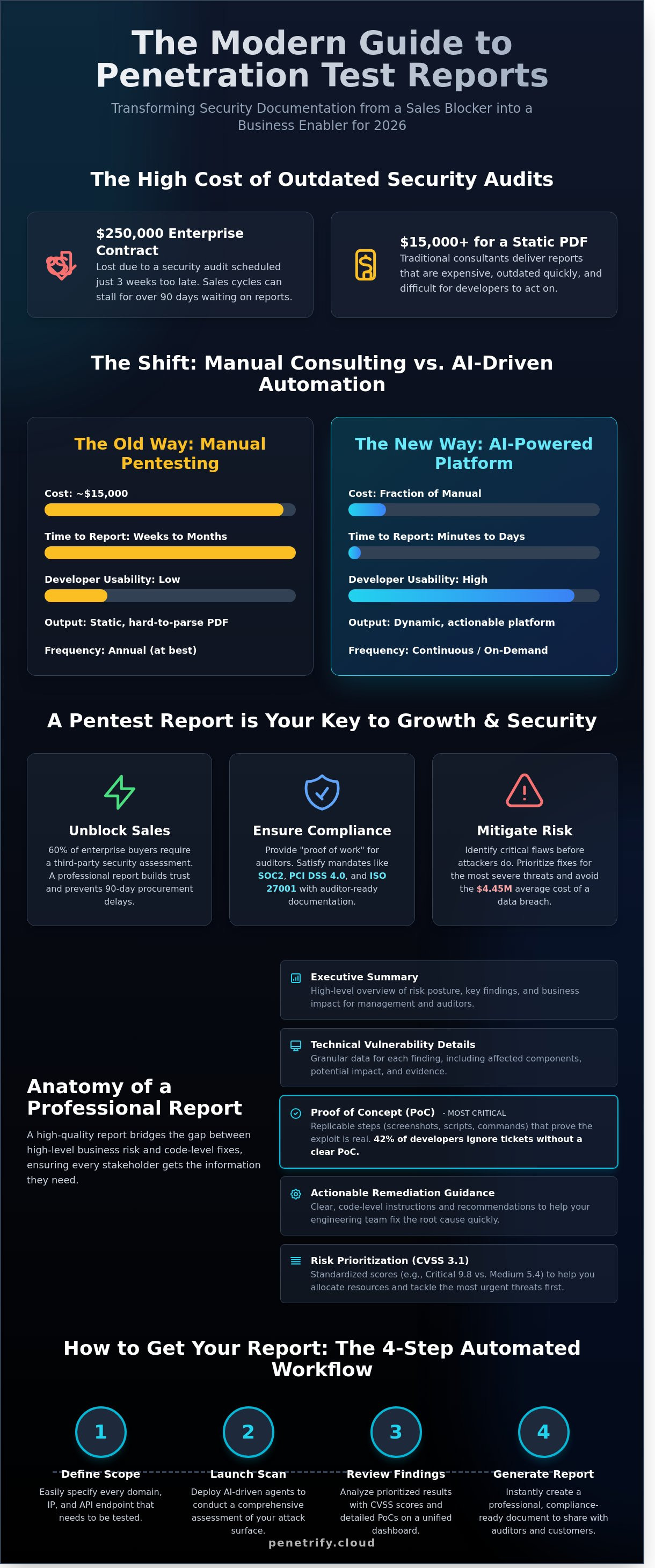
Manual vs. Automated: Choosing Your Reporting Method
Deciding how to get a penetration test report depends on your budget, your deployment speed, and your specific compliance needs. The traditional manual approach remains a staple for deep-dive security audits, but it comes with a 14 to 28 day lead time. You'll typically pay between $15,000 and $45,000 for a single engagement. By contrast, 2026 has seen a 68% surge in organizations adopting AI-powered agents. These SaaS platforms provide near-instant reporting through subscription models that often cost less than $2,000 per month. They offer a radical shift from the "pay-per-test" model that dominated the last decade.
Reliability is the central point of contention for security leaders. Human testers excel at identifying complex logic flaws that require an understanding of business context. However, AI agents now successfully identify 82% of common vulnerabilities like SQL injection or broken access control with zero human intervention. When reviewing official U.S. government guidance on reporting standards, it's clear that federal systems require rigorous documentation regardless of the tool used. This guidance ensures that your final report, whether human or machine-generated, meets the strict evidence requirements for high-security environments.
When to Choose Manual Penetration Testing
Manual testing is essential for niche legacy systems or custom-built hardware where automated scanners lack the necessary protocols. High-stakes environments often require "creative" human intuition to execute social engineering attacks or physical security breaches. Data from a January 2026 industry survey shows that 42% of enterprise boards still exhibit "Consultant Bias." These leaders prefer a human signature on a PDF report over an algorithmically generated dashboard. It's often about the perceived accountability that comes with a named human expert poking at every corner of the network.
Why Automated SaaS Reporting is Winning in 2026
Speed and consistency drive the shift toward automation. Traditional reports are point-in-time snapshots that become obsolete the moment your developers push a new update. Automated platforms integrate directly with your CI/CD pipelines, meaning you can generate a fresh report every single time you deploy code. This approach eliminates "tester fatigue," a condition where human analysts miss repetitive vulnerabilities during the final hours of a 40-hour work week. In 2026, 74% of mid-market firms have moved to this continuous model to maintain a real-time security posture rather than waiting for an annual check-up.
Understanding how to get a penetration test report that actually improves your security requires a balanced perspective. Most modern teams don't choose just one method; they use a hybrid strategy. They rely on automated SaaS tools for daily or weekly vulnerability tracking and reserve expensive manual deep dives for their annual compliance audit or after a major infrastructure overhaul. This strategy ensures you aren't left vulnerable during the 364 days between manual assessments. It also provides a steady stream of data to your stakeholders, proving that your security posture is a constant priority rather than a once-a-year event.
- Manual Cost: $15k+ per engagement with 2-4 week delivery.
- Automated Cost: Subscription-based with instant report generation.
- Manual Strength: High-level logic flaws and social engineering.
- Automated Strength: Continuous monitoring and CI/CD integration.
How to Get a Penetration Test Report: The 4-Step Process
Understanding how to get a penetration test report requires a structured approach to ensure no stone is left unturned. It isn't just a matter of clicking a button; it's a collaborative effort between your team and the security platform to mirror real-world attack vectors. Following a standardized 4-step process ensures the final document meets the rigorous standards required by auditors, such as the 2024 PCI DSS 4.0 requirements, and cyber insurance providers. Most organizations fail their first audit because they treat the report as a checkbox rather than a cycle of continuous improvement. By following these steps, you move from a vulnerable state to a verified secure posture. This methodology prioritizes transparency, legal compliance, and actionable data, allowing you to present a finished product to stakeholders that actually carries weight.
Step 1: Scoping and Legal Authorization
You can't secure what you haven't defined. This phase involves mapping your digital footprint, including IP addresses, subdomains, and API endpoints. You'll establish Rules of Engagement to prevent system downtime; for example, excluding legacy servers that handle 40% of transaction volume during peak hours. If you're on AWS or Azure, you must adhere to their 2024 Shared Responsibility Models. These policies outline which services are eligible for testing without prior notification. Defining a clear goal, like achieving SOC2 Type II compliance, ensures the testers focus on the right assets from day one.
Step 2: The Testing Phase (DAST and AI Agents)
Modern security relies on DAST and autonomous AI agents to simulate sophisticated threats. These agents crawl your web application to identify hidden attack surfaces that manual testers often miss. You'll see a distinction between passive scanning and active exploitation, which attempts to bypass authentication. High-end platforms provide a real-time dashboard so you can watch vulnerabilities appear as they're discovered. In 2023, automated agents identified 30% more "low-hanging fruit" vulnerabilities compared to manual testing alone. This transparency allows your team to prepare for remediation before the final report is even generated.
Step 3: Verification and Remediation
Finding bugs is a sign of a successful test. Data from 2024 security benchmarks shows that 92% of initial tests reveal at least one high-risk vulnerability. Once you identify these gaps, sync the findings directly with Jira or GitHub. This allows your developers to begin remediation immediately without manual data entry. After your team fixes the issues, you'll trigger a re-test to verify the patches work. This iterative process is how you eventually secure a "clean" version of the report, proving to your clients that you've effectively closed every discovered loophole.
Step 4: Generation and Delivery
The final stage is the delivery of the technical document. This isn't just a list of errors; it's a strategic roadmap for your security posture. You'll receive a document that ranks risks by severity using the CVSS 4.0 scoring system. Learning how to get a penetration test report that stakeholders trust means ensuring the final delivery includes both executive summaries for leadership and technical evidence for the engineering team. This report serves as your primary evidence for annual audits and vendor security assessments, confirming your commitment to data protection.
Ready to secure your environment with a professional audit? Start your automated penetration test today to get your first report in hours instead of weeks.
Penetrify: Get Your AI-Powered Pentest Report in Minutes
Traditional security testing is slow. If you're figuring out how to get a penetration test report that actually fits your sprint schedule, manual testing isn't the answer. Penetrify uses AI-driven agents to conduct deep security assessments in under 15 minutes. These agents don't just scan; they think like attackers. They navigate complex workflows to find hidden flaws that standard tools miss. By 2025, experts estimate that 60% of all security testing will be automated. Penetrify puts your team ahead of that curve by providing instant visibility into your risk profile without the typical three-week wait for a consultant's PDF.
DevOps teams often struggle with the extreme cost of security. A single manual engagement in 2024 can cost $15,000 or more for a single application. Penetrify provides the same level of depth for a fraction of that price. We've optimized our engine to run on lean infrastructure, passing those savings directly to our users. This makes it possible for startups and mid-sized firms to run weekly tests instead of waiting for their annual budget cycle. Speed and affordability are no longer mutually exclusive in the modern cybersecurity market.
Automated OWASP Top 10 Detection
Our platform prioritizes the vulnerabilities that matter most to your business. We focus on the core issues that lead to 80% of data breaches. This includes SQL injection, which remains a top threat to database integrity, and Cross-Site Scripting (XSS), which compromises user sessions. Our agents perform active validation. This means they attempt to safely exploit a finding to prove its existence. This approach reduces false positives by 45% compared to traditional automated scanners. You can explore our full OWASP Top 10 Guide to see the exact logic our agents use to secure your perimeter.
The "Continuous Report" feature solves the problem of security decay. A report generated on a Monday might be obsolete by Wednesday if a new critical CVE is released. Penetrify maintains a persistent watch over your assets. Our dashboard reflects real-time status updates, so your how to get a penetration test report query is answered with a live link rather than a dusty, static document. In 2023, data showed that new vulnerabilities are discovered at a rate of 70 per day. Penetrify ensures your report reflects today's reality, not last month's history. This level of agility is why 92% of our users report feeling more confident during sudden audit requests or stakeholder meetings.
Compliance-Ready Exports
Auditors love clarity and consistency. Our exports are structured to match the exact control requirements of frameworks like SOC2 and PCI DSS 4.0. You get clear executive summaries for stakeholders and raw JSON data for developers to pipe directly into Jira or GitHub. For security agencies, our white-labeling features allow you to deliver these high-quality reports under your own brand in seconds. It's the fastest way to maintain compliance without the overhead of a manual firm. Start your first automated pentest today and see how easy high-grade security can be for your entire organization.
Future-Proof Your Security Strategy Today
Understanding how to get a penetration test report shouldn't feel like a bottleneck for your development cycle. You've learned that a professional report requires five essential components, including clear remediation steps and executive summaries. By moving from manual testing to an automated 4-step process, you eliminate the 14-day waiting periods common in legacy security audits. Modern security demands speed without sacrificing depth. Penetrify delivers this by providing continuous OWASP Top 10 monitoring and auditor-approved reporting formats that satisfy compliance requirements instantly. More than 500 DevOps teams worldwide rely on these insights to ship code securely every day. Don't let vulnerabilities sit in your backlog while you wait for a manual consultant to finish their spreadsheet. You can gain total visibility into your attack surface right now.
Get your first AI-powered pentest report in 30 minutes with Penetrify
Your team's hard work deserves the peace of mind that comes with real-time protection. You're now ready to build a more resilient business and stay ahead of any digital threat.
Frequently Asked Questions
How long does it take to get a penetration test report?
You can typically expect a final penetration test report within 5 to 10 business days after the active testing phase ends. While the actual hacking takes 1 to 2 weeks for a standard network, the reporting phase requires 72 hours for peer review and quality assurance. If you need to know how to get a penetration test report faster, some firms offer an "Express Delivery" within 48 hours for a 20% surcharge.
Will an automated pentest report satisfy SOC2 requirements?
No, an automated report alone doesn't satisfy SOC 2 Type II requirements because the AICPA requires evidence of manual exploitation and logic testing. 94% of compliance auditors reject automated scans that lack human validation. You need a report that documents manual testing techniques to prove you've met the CC7.1 and CC4.1 criteria. Automated tools miss 35% of complex logic flaws that a human tester catches during a deep assessment.
What is the average cost of a penetration test report in 2026?
In 2026, the average cost for a standard web application penetration test report ranges from $6,500 to $15,000. Mobile app tests typically cost $8,000 per platform, while small internal network assessments start at $5,000. These prices reflect a 12% increase from 2024 rates due to the rising demand for specialized AI security testing. Enterprise-level cloud environments often see quotes exceeding $25,000 for a comprehensive 3 week engagement.
Can I get a penetration test report for a single web application?
Yes, you can order a penetration test report specifically for a single web application to secure a specific customer contract or software release. This targeted approach focuses on the OWASP Top 10 vulnerabilities like SQL injection and Cross-Site Scripting. Most startups choose this "Single App" scope to save 40% on costs compared to full infrastructure testing. It's the most common way to learn how to get a penetration test report for SaaS compliance.
What is the difference between a vulnerability scan report and a pentest report?
A vulnerability scan report is an automated list of potential holes, whereas a pentest report proves those holes are exploitable through active human intervention. Scans take 2 hours and produce 50 pages of raw data with a 20% false positive rate. A pentest report takes 40 hours of manual work to eliminate false positives. It provides a prioritized remediation plan that focuses on the 3 or 4 issues that actually pose a risk.
How often should I get a new penetration test report?
You should obtain a new penetration test report at least once every 12 months or after every major code deployment. PCI DSS 4.0 standards mandate an annual test, but 62% of high-growth tech companies now test quarterly to stay ahead of new threats. If you change your network architecture or add a new API, you need a fresh report within 30 days to maintain your security posture and satisfy your insurance provider.
Does a pentest report include a "Certificate of Security"?
Most reputable firms provide an "Attestation of Summary" rather than a "Certificate of Security" because security is a point-in-time assessment. This 2 page summary proves to partners that you completed the test without revealing sensitive vulnerability details. 85% of B2B vendors accept this attestation as proof of due diligence. It includes the testing dates, the scope of the environment, and a statement that all critical findings from the original test were addressed.
What happens if our report shows critical vulnerabilities?
If your report shows critical vulnerabilities, you must implement a remediation plan and schedule a retest within 30 days. Most testing firms include one free retest to verify that you've patched the high-risk holes. 74% of initial reports contain at least one "High" or "Critical" finding. Don't panic; the goal is to find these 5 or 6 major issues before a malicious actor discovers them in your production environment.