

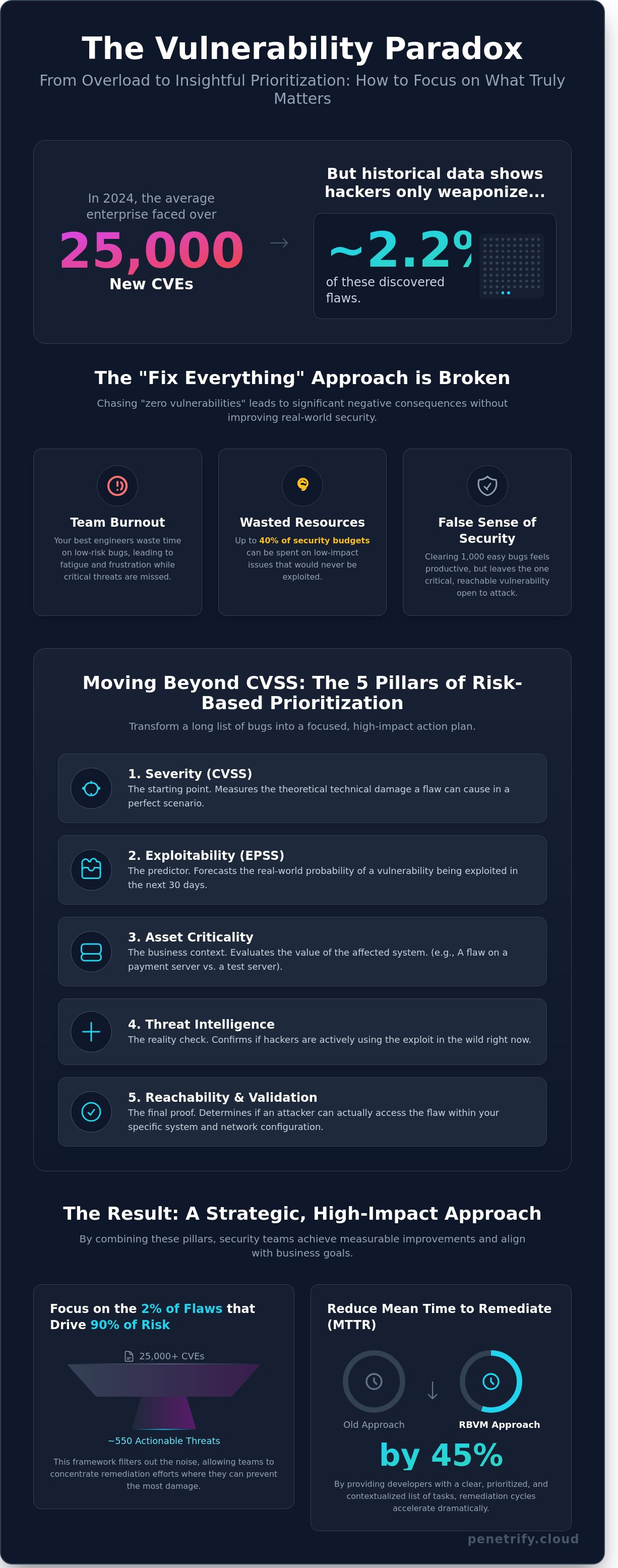
In 2024, the average enterprise was hit with over 25,000 new CVEs, yet historical data shows that hackers only weaponize about 2.2% of these flaws. If your team treats every high-severity alert like a house fire, you aren't just wasting time; you're burning out your best engineers on bugs that pose zero real-world threat. You likely agree that the current "fix everything" approach is broken, and your developers are tired of hearing that every single ticket is a top priority.
We're here to help you regain control by mastering how to prioritize security vulnerabilities through a repeatable, automated framework designed for the 2026 threat landscape. You'll learn how to cut through the noise and isolate the specific 2% of vulnerabilities that represent 90% of your actual business risk. We will explore how to implement reachability analysis and exploit intelligence to reduce your mean-time-to-remediate (MTTR) by 45% while finally aligning your security efforts with your most critical business assets.
Key Takeaways
- Stop chasing "zero vulnerabilities" and learn why focusing on high-volume patching leads to team burnout rather than improved security.
- Discover how to prioritize security vulnerabilities using a risk-based framework to identify the 2% of flaws that drive 90% of your risk profile.
- Move beyond basic CVSS scores by integrating EPSS and business context to understand the real-world probability and impact of an exploit.
- Master a repeatable 5-step workflow to catalog assets and contextualize raw scan results for more effective, high-impact remediation.
- Learn how to automate vulnerability validation through continuous security testing to keep pace with modern, fast-moving CI/CD pipelines.
The Vulnerability Paradox: Why You Can’t Patch Everything in 2026
The sheer volume of security alerts has reached a breaking point. Data from recent industry reports indicates that 60% of enterprises now manage over 500 security incidents every single week. This flood of data creates a "noise" problem where critical signals get lost in a sea of minor alerts. Chasing "patch perfection" by trying to fix every single flaw is a recipe for team burnout. It often causes security teams to miss actual, sophisticated threats while they're busy updating non-critical software components.
To better understand this concept, watch this helpful video:
Smart organizations are moving away from reactive scanning. They're adopting risk-based vulnerability management (RBVM). This shift transforms Vulnerability management from a mindless checklist into a strategic risk-reduction exercise. Learning how to prioritize security vulnerabilities involves looking beyond just the severity score of a bug to understand its potential impact on your specific infrastructure.
The Cost of Misaligned Priorities
When teams focus on the wrong targets, the financial impact is stark. Misaligned priorities can waste up to 40% of a security budget on low-risk issues that would never have been exploited. This creates a dangerous "False Sense of Security." You might clear 1,000 easy-to-fix flaws while leaving one critical, reachable back door open. This approach also damages developer relations. When security acts as a bottleneck by demanding fixes for irrelevant bugs, it slows down release cycles and creates unnecessary friction between departments.
Theoretical vs. Actual Risk
A "Critical" CVSS score doesn't always translate to a critical business risk. You have to consider "Reachability." If a flaw exists in a library that your application doesn't actually call, or if it's buried deep in an internal system with no path from the internet, the urgency drops. An external-facing server with a "Medium" vulnerability often poses a higher threat than an isolated internal test machine with a "High" vulnerability. Knowing how to prioritize security vulnerabilities requires analyzing where the asset lives and whether an attacker can realistically touch the flaw.
Moving Beyond CVSS: The 5 Pillars of Risk-Based Prioritization
Relying solely on CVSS scores is a recipe for burnout. While CVSS provides a baseline measure of technical severity, it ignores the context of your specific environment. Learning how to prioritize security vulnerabilities requires looking at five core pillars that transform a long list of bugs into a focused action plan.
- Severity (CVSS): This measures the theoretical damage a flaw causes. It's your starting line, not the finish.
- Exploitability (EPSS): This predicts the likelihood of an attacker using the flaw within a specific timeframe.
- Asset Criticality: This evaluates the business value of the affected system.
- Threat Intelligence: This confirms if hackers are currently using the exploit in real-world attacks.
- Validation: This proves whether your specific security controls or configurations actually allow the exploit to work.
Many industry leaders are moving toward risk-based vulnerability prioritization to manage the 25,000+ new CVEs discovered annually. By focusing on these pillars, you ensure that high-effort remediation resources target the highest-risk flaws first.
EPSS: The Secret Weapon for Modern Security Teams
The Exploit Prediction Scoring System (EPSS) is more predictive than CVSS because it uses real-world data to forecast attack probability. Integrating EPSS helps teams understand how to prioritize security vulnerabilities by shifting focus from theoretical bugs to active threats. Research shows that 90% of vulnerabilities have a near-zero probability of ever being exploited. By focusing on flaws with high EPSS scores, teams often reduce their remediation workloads by 85% without increasing their risk profile. Use a dual-factor model: prioritize anything with a CVSS score above 7.0 that also carries an EPSS score higher than 0.1.
Quantifying Asset Criticality
Asset Criticality is the business-impact multiplier for any technical flaw. You can't treat a dev server the same as your primary database. Use this simple tiering system to categorize your environment:
- Tier 1: Revenue-generating systems, customer-facing apps, and core databases.
- Tier 2: Internal operations, employee productivity tools, and HR systems.
- Tier 3: Development, testing, and sandbox environments.
Weight your priority list by data sensitivity. A "Medium" vulnerability on a server containing PII, PCI, or HIPAA data is more dangerous than a "Critical" bug on an empty test machine. Using automated validation tools helps confirm which of these critical assets are truly reachable and exploitable in your current state.
Top Vulnerability Prioritization Frameworks Compared
Security teams often realize that relying solely on CVSS scores leads to "alert fatigue." A 2023 analysis revealed that only 5% of published vulnerabilities are ever actually exploited in the wild. This massive gap is why understanding how to prioritize security vulnerabilities requires more than a base score. No single framework serves as a silver bullet for every organization. High-maturity teams select models that support automation and integrate directly into CI/CD pipelines to ensure remediation keeps pace with rapid deployment cycles.
SSVC (Stakeholder-Specific Vulnerability Categorization)
Developed by Carnegie Mellon and promoted through CISA's vulnerability management framework, SSVC moves away from static numbers. It uses customized decision trees to categorize flaws into four clear actions: Defer, Scheduled, Out-of-Cycle, or Immediate. This logic forces teams to evaluate "Exploitation" and "Technical Impact" based on their specific environment. While it provides actionable outcomes, it's complex to scale. Organizations managing over 5,000 assets usually find that manual SSVC is impossible; they require automated data inputs to feed the decision engine in real time.
Risk-Based Vulnerability Management (RBVM)
RBVM shifts the focus from technical severity to actual business risk. While traditional scanners tell you what's broken, RBVM platforms analyze what's actually important to your operations. These systems combine internal asset criticality with external threat intelligence. For modern web applications, AI-driven RBVM can reduce remediation backlogs by 40% by filtering out vulnerabilities that lack an active exploit path or reside in isolated environments.
Successful RBVM implementation relies on three main components:
- Asset Criticality: Prioritizing the database containing customer PII over a dev-stage sandbox.
- Threat Intelligence: Identifying which CVEs are currently being weaponized by ransomware groups.
- Vulnerability Reachability: Using AI to determine if a vulnerable code library is actually reachable by an external attacker.
Learning how to prioritize security vulnerabilities through the lens of RBVM ensures your developers don't waste 20 hours a week fixing "Critical" bugs that have zero internet exposure. It's about focusing on the 2% of vulnerabilities that pose 90% of the risk to your revenue.
A 5-Step Workflow to Prioritize Vulnerabilities Like a Pro
Understanding how to prioritize security vulnerabilities requires moving beyond raw CVSS scores. A structured workflow ensures your team tackles the 2% of flaws that actually pose a threat to your specific infrastructure. Follow these five steps to streamline your defense.
- Step 1: Discover and Catalog. You can't protect what you don't track. Build a real-time inventory of all external and internal assets to eliminate shadow IT. Use a Continuous Asset Attack Surface Management (CAASM) approach to maintain an accurate list.
- Step 2: Contextualize. Assign business value to every asset. A vulnerability on a public-facing payment gateway is a higher priority than the same flaw on a disconnected test server. Risk is the intersection of vulnerability and asset importance.
- Step 3: Filter by Threat Intel. Cross-reference your scan results with the CISA Known Exploited Vulnerabilities (KEV) catalog, which has tracked active threats since November 2021. Use Exploit Prediction Scoring System (EPSS) data to see which bugs have a high probability of being weaponized in the next 30 days.
- Step 4: Validate via Automated Pentesting. This is the "Penetrify" approach. Move from theoretical risk to proven risk by attempting safe exploitation to see if a flaw is actually reachable.
- Step 5: Remediate and Verify. Patch the flaw, but don't stop there. Re-test the asset to ensure the fix is effective and hasn't introduced new configuration issues.
Step 4: The Power of Validation
Traditional vulnerability scanners often produce a 30% false positive rate, which leads to alert fatigue. Validation is the missing link. By using AI agents to attempt safe exploitation, you confirm reachability. If an attacker can't actually reach the vulnerable code due to existing network controls, the risk is lower than the scanner suggests. This process eliminates ghost vulnerabilities and ensures your developers only work on issues that truly matter.
Setting Your Remediation SLAs
Effective teams use risk-based data to set realistic Service Level Agreements (SLAs). For example, a critical validated risk might require a 24-hour fix. A high-risk flaw might have a 7-day window, while lower-risk items can wait for 30-day or 90-day cycles. Using a how to prioritize security vulnerabilities framework allows you to justify these longer timelines to auditors because you've proven the low-risk flaws aren't exploitable. SLAs must be based on validated risk and asset context rather than generic scanner severity levels.
Ready to stop chasing false positives? Validate your security posture with Penetrify's automated platform and focus on what matters.
Automating Prioritization with Continuous Security Testing
Manual triage fails because modern CI/CD pipelines deploy code 10 or 20 times daily. Traditional security teams often find themselves buried under thousands of alerts from static scanners. These tools flag everything as "critical," yet 85% of those vulnerabilities are never actually reachable by an attacker. This overwhelming volume makes it nearly impossible to understand how to prioritize security vulnerabilities without losing weeks to manual verification. Penetrify solves this by integrating directly into your workflow to automate the validation of every new discovery.
Our AI-powered agents crawl and test web applications at 50 times the speed of a human tester. They don't just look for missing patches. They actively attempt to exploit flaws in a safe, controlled environment. This shifts your organization away from "point-in-time" annual pentesting, which is often obsolete 24 hours after completion. Instead, you gain an "always-on" security validation layer that keeps pace with every code commit and infrastructure change.
The Penetrify Advantage: AI-Driven Reachability
Our intelligent agents simulate real-world attack chains to identify critical paths through your application. While a standard scanner might tell you a library is outdated, Penetrify determines if that library is actually exploitable in under 15 minutes. We move the conversation from "what is vulnerable" to "what is exploitable." This distinction is vital for efficiency. We provide developers with evidence-based reports, including full request/response logs. These reports eliminate the "it works on my machine" debate and ensure engineers act on data they actually trust. This process typically reduces security noise by 75% for our users.
Getting Started with Continuous Assessment
You can connect your web applications to Penetrify to establish an instant security baseline in less than 10 minutes. Once the baseline is set, the platform monitors for regressions and new threats. We push validated, high-priority results directly into Jira or Slack, fitting perfectly into your existing remediation workflows. This automation ensures that your team stops guessing and starts fixing the flaws that matter most. If you want to transform how to prioritize security vulnerabilities within your dev team, start your first automated pentest with Penetrify today and see the difference that evidence-based prioritization makes.
Secure Your 2026 Infrastructure with Risk-Based Intelligence
Security in 2026 doesn't allow for a "patch everything" mentality. By focusing on the 5 pillars of risk-based prioritization and moving beyond static CVSS scores, you've learned how to prioritize security vulnerabilities based on actual exploitability. Transitioning to a 5-step automated workflow ensures your team stops chasing low-impact bugs and addresses critical 2026 threats first. Modern security leaders use these frameworks to cut through the noise of thousands of daily alerts.
Manual testing often takes weeks, but your infrastructure demands immediate speed. Penetrify's AI-powered agents identify the most critical web application vulnerabilities in under 10 minutes. This provides a 75% cost reduction compared to traditional manual pentesting services. You can integrate continuous monitoring directly into your CI/CD pipelines to ensure every deployment stays secure from the first line of code. Stop relying on outdated spreadsheets and start using real-time validation to protect your digital assets.
Stop guessing and start validating; get a free security scan from Penetrify. Your defense strategy is ready for a powerful upgrade.
Frequently Asked Questions
Is CVSS 4.0 enough for vulnerability prioritization?
No, CVSS 4.0 isn't enough because it lacks your specific business context. While the November 2023 update adds the Supplemental Metric Group, it doesn't account for your internal network topology or specific asset value. You'll likely miss the 5% of vulnerabilities that pose 80% of your actual risk without local environmental data. Relying solely on a base score ignores whether a system is actually reachable.
What is the difference between vulnerability scanning and automated pentesting?
Vulnerability scanning identifies potential flaws by checking software versions, while automated pentesting actively attempts to exploit them. Pentesting tools validate whether a bug is reachable, which often reduces false positive rates by 40% or more. This validation is a key step in learning how to prioritize security vulnerabilities effectively within a busy security team. It moves you from a long list of "maybes" to a short list of "definites."
How often should I prioritize my vulnerability backlog?
You should prioritize your backlog at least once a week or continuously via automation. With over 25,000 new CVEs published in 2023 alone, a monthly review leaves you exposed to exploits that hackers weaponize in under 7 days. Real-time updates ensure your team focuses on the 2% of flaws that are actually being exploited in the wild. Waiting for a quarterly report is no longer a viable strategy.
Can AI really prioritize vulnerabilities better than a human?
AI prioritizes high-volume data faster than humans, but it works best as a decision-support tool. A machine can analyze 10,000 data points across 500 assets in seconds; a human analyst would take 40 hours to complete the same task. However, humans are still required to understand the 10% of cases where business logic or compliance requirements override technical risk scores. It's about speed, not total replacement.
What is the CISA KEV list and why does it matter?
The CISA Known Exploited Vulnerabilities (KEV) list is a catalog of flaws that attackers are actively using in the wild. Established under Binding Operational Directive 22-01, it currently contains over 1,000 entries. It matters because these vulnerabilities are the most likely to result in a breach, making them the first items you should address. Organizations that ignore the KEV list face a much higher probability of a successful compromise.
How do I convince developers to fix vulnerabilities faster?
You convince developers by providing proof of exploitability rather than just a PDF report. When security teams provide a "path to exploit," developer friction drops by 30% because they aren't wasting time on false positives. Use data from your automated pentesting tools to show exactly how a bug impacts the 3 most critical business functions. Clear evidence turns a theoretical argument into a necessary technical task.
What happens if we can't patch a critical vulnerability immediately?
You must implement compensating controls like WAF rules or network segmentation if a patch isn't possible. Since 60% of data breaches involve unpatched vulnerabilities, these temporary measures are vital. Use micro-segmentation to isolate the 1 affected server from the rest of your production environment until the vendor releases a fix. This reduces the blast radius while your team works on a permanent solution during the next window.
Is automated penetration testing safe for production environments?
Modern automated pentesting is safe for production when you use non-destructive payloads and safe-check configurations. Most enterprise tools maintain a 99.9% uptime record by avoiding "denial of service" style tests. This approach is essential when figuring out how to prioritize security vulnerabilities because it provides real-world data without disrupting your 24/7 revenue-generating services. It's safer than leaving an untested, vulnerable system exposed to actual malicious actors.