

If your security scanner still treats your React or Angular app like a collection of static HTML pages, it’s probably ignoring 40% of your vulnerable code. Most legacy DAST tools simply can’t see past the initial loading screen, leaving your client-side routes and JSON-based APIs completely exposed. Effective security testing for single page applications (spa) requires more than just a basic crawl; it needs to understand the logic of modern frameworks. You’ve likely felt the frustration of high false positive rates or the bottleneck of waiting for a manual pentest to clear a weekly release.
It's time to stop settling for incomplete coverage that puts your 2026 roadmap at risk. This guide shows you how to implement a modern, AI-driven security strategy that bridges the gap between fast development and robust protection. You’ll discover how to integrate automated testing directly into your CI/CD pipeline, ensuring every API endpoint is validated before it hits production. We’re going to break down the exact steps to achieve full attack surface visibility while reducing your reliance on expensive manual audits by 60% or more.
Key Takeaways
- Understand why traditional scanners often fail at security testing for single page applications (spa) and how to bridge the "crawl gap" in modern frameworks.
- Discover how to implement comprehensive security testing for single page applications (spa) by securing the three pillars: frontend, APIs, and dependencies.
- Learn to move beyond basic Ajax spiders by leveraging AI-powered agents for security testing for single page applications (spa) that execute full JavaScript and handle multi-step forms.
- Master the configuration of DAST tools for authenticated security testing for single page applications (spa), ensuring your token management remains secure across React, Vue, and Angular apps.
- Explore how continuous AI-driven security testing for single page applications (spa) evolves alongside your code to identify vulnerabilities that traditional point-in-time scans miss.
What is SPA Security Testing and Why is it Different?
Security testing for single page applications (spa) represents a major departure from the methodologies used for traditional multi-page applications. In a standard web environment, the server handles the heavy lifting by rendering HTML and sending it to the browser. When you click a link, the browser requests a new page. However, modern development has shifted toward "thick clients" where the browser takes over the orchestration of the user experience. To understand the architectural foundation of these tools, it helps to review What is a Single-Page Application (SPA)? and how it maintains state without full page reloads.
To better understand this concept, watch this helpful video:
The fundamental shift involves moving logic from the server-side to the client-side. In an SPA, the initial load delivers a bundle of JavaScript, CSS, and HTML. From that point forward, the application communicates with the backend via REST or GraphQL APIs to fetch raw data, usually in JSON format. This decoupling means that security testing for single page applications (spa) must focus on two distinct fronts: the client-side execution environment and the headless API layer. If a tester only focuses on the visible UI, they miss the underlying data exchanges that attackers often target.
The 'Crawl Gap' Problem
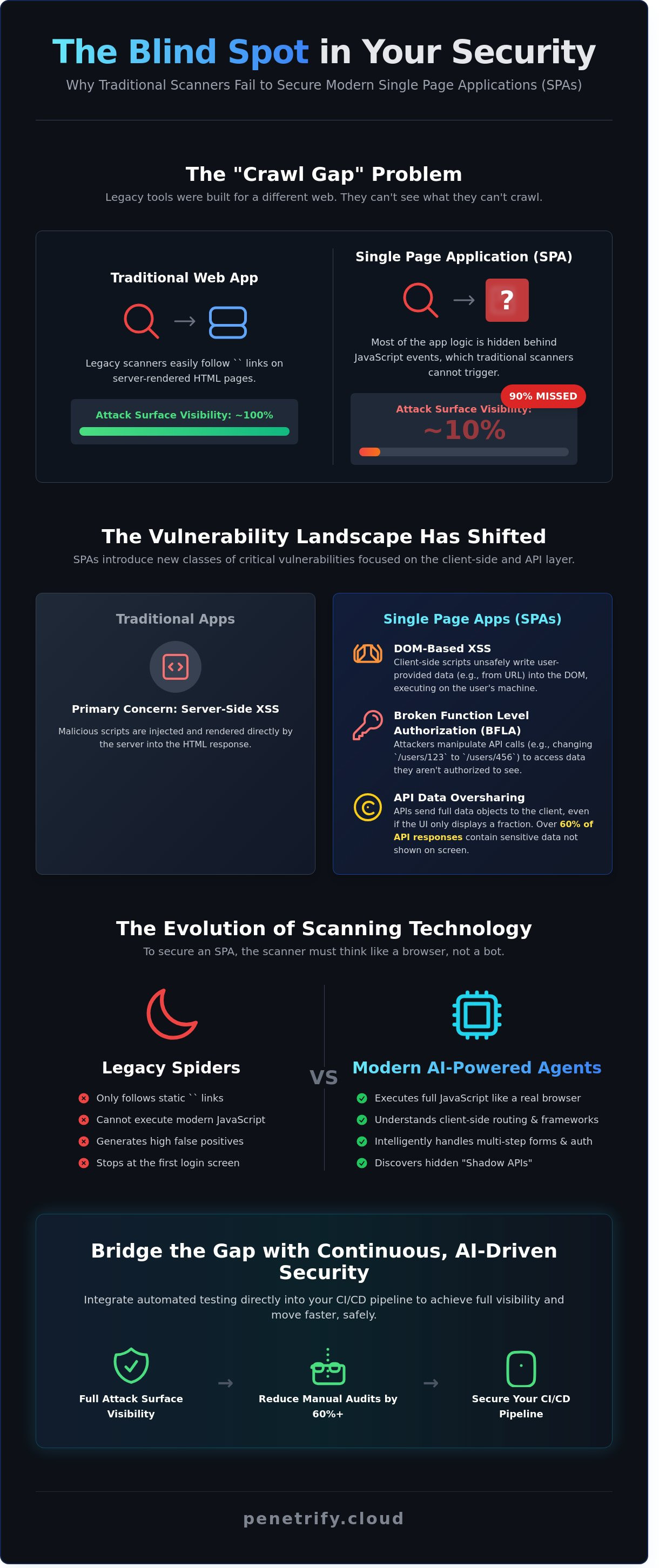
Legacy vulnerability scanners were built for the 2005 era of the web. They work by "crawling" a site, which means they look for <a> tags and follow them to map the attack surface. In a React or Vue.js application, these links often don't exist in the source code. Instead, client-side routing libraries like React Router manipulate the browser's history API to change the view without a request to the server. A 2022 study of automated scanning tools found that traditional DAST scanners often miss up to 90% of an SPA's logic because they can't trigger the JavaScript events required to render the DOM. When a scanner reports zero vulnerabilities, it's frequently because it only saw the login page and couldn't "see" the rest of the app.
SPA vs. Traditional Web App Vulnerabilities
The move to client-side rendering has changed the nature of common exploits. While traditional applications struggled with server-side Cross-Site Scripting (XSS), SPAs are more susceptible to DOM-based XSS. This happens when the application takes data from a source, like a URL parameter, and writes it to the Document Object Model (DOM) in an unsafe way. Because the browser is doing the rendering, the execution happens entirely on the user's machine, often bypassing server-side filters.
Additionally, the API-centric nature of SPAs introduces Broken Function Level Authorization (BFLA). Since the frontend logic is visible to anyone who opens the browser's developer tools, attackers can see every API endpoint the app uses. They might find an endpoint like /api/v1/users/1234 and manually change the ID to see if the server returns data for another user. This leads to a common issue called data oversharing. Developers often send a full JSON object to the frontend, containing 15 or 20 fields, even if the UI only displays three. According to 2023 industry benchmarks, over 60% of API responses in SPAs contain sensitive data that's never actually rendered on the screen but remains accessible to anyone inspecting the network traffic.
Mapping the Attack Surface of Modern SPAs
Modern SPAs move the heavy lifting from the server to the browser. This shift creates a decentralized attack surface that traditional scanners often miss. Effective security testing for single page applications (spa) begins by breaking the architecture into three distinct pillars: the client-side frontend logic, the API communication layer, and the web of third-party dependencies. Each pillar presents unique entry points for attackers. If you only test the UI, you leave the engine room unguarded.
You can't secure what you haven't identified. A 2023 report from Salt Security revealed that 94% of surveyed organizations experienced security issues in production APIs. Many of these incidents stem from "Shadow APIs." These are undocumented endpoints created by developers to support specific frontend features that the security team never vetted. Your testing must start with a discovery phase. This involves intercepting all outbound traffic to map every endpoint, including those not explicitly listed in your Swagger or OpenAPI documentation.
Frameworks like React, Vue, and Angular operate under a shared responsibility model. While these frameworks provide built-in protection against certain types of Cross-Site Scripting (XSS), they don't handle authorization or secure data storage by default. Implementing Best practices for SPA security requires recognizing that the framework is a tool, not a complete security solution. Developers must still manually configure security headers and validate all data on the server side.
Testing the Frontend Logic
The client-side environment is an open book for attackers. During an audit, testers must scrutinize LocalStorage and SessionStorage for sensitive data. Developers often mistakenly store JWTs or PII in these areas, making them vulnerable to extraction via XSS. Another common oversight is leaving source maps active in production. This allows an attacker to reconstruct the original TypeScript or JavaScript source code, making it easy to find hidden logic. We frequently find business logic bypasses where the UI hides a button for unauthorized users, but the underlying JavaScript still contains the function calls needed to perform the action. If you're concerned about your current exposure, a professional security audit can help identify these client-side leaks.
Testing the API Communication Layer
The API is the actual security perimeter of an SPA. Robust security testing for single page applications (spa) requires interacting with JSON, Protobuf, or GraphQL endpoints directly. You must bypass the frontend entirely to see how the server reacts to unexpected payloads. Many legacy DAST tools fail here because they don't understand modern authentication patterns like OAuth2 or Bearer tokens. Fuzzing these API inputs is critical. A frontend might sanitize a "Comments" field to prevent script execution, but the server might still be vulnerable to injection if it assumes the frontend has already cleaned the data. Testing must verify that every API call enforces strict server-side validation, regardless of what the UI allows.
- Direct Endpoint Fuzzing: Sending malformed data to GraphQL queries to trigger informative errors.
- Auth Token Manipulation: Attempting to use expired or tampered JWTs to access restricted resources.
- State Injection: Modifying the application state in the browser to see if the backend honors unauthorized changes.
Legacy Spiders vs. AI-Powered Security Agents
The transition from server-side rendering to client-side logic changed how we approach security testing for single page applications (spa). Traditional scanners were designed for a world where every click triggered a new page load. In a modern SPA, the application state changes without the URL ever shifting. This architecture renders legacy "Ajax Spiders" largely obsolete. These older tools attempt to map an application by following links, but they often fail to trigger the specific JavaScript events required to reveal hidden API endpoints. By 2026, the industry has shifted toward autonomous agents that don't just crawl; they interact.
The Limits of Headless Browsers
For years, security teams relied on headless browsers like Puppeteer or Playwright to render JavaScript during a scan. This method is incredibly resource heavy. Running 100 Chrome instances simultaneously to scan a single enterprise-grade SPA can consume over 32GB of dedicated RAM just to maintain stability. This inefficiency leads to the "timeout trap." If a React or Vue component takes longer than 2.5 seconds to hydrate, the scanner frequently times out and assumes the page is empty. It misses entire sections of the attack surface because the DOM wasn't ready. These tools also struggle with complex UI interactions. A legacy scanner can't easily navigate a drag-and-drop file uploader or a multi-nested modal window without extensive manual configuration.
Security debt often accumulates because these scanners fail to reach deep application states. Research from the University of Tartu highlights that integrating security into the SPA development lifecycle requires a shift toward tools that understand component-based architecture. Without this understanding, scanners remain blind to the vulnerabilities hidden within client-side routing and state management libraries.
Why AI-Driven Pentesting is the 2026 Standard
AI-powered security agents represent the most significant leap in security testing for single page applications (spa) since the invention of the headless browser. These agents use large language models and reinforcement learning to "understand" the purpose of a page. If an AI agent encounters a form with fields for "Card Number" and "Expiry," it recognizes a checkout flow. It doesn't just inject random strings; it simulates a real user journey to reach the final submission button where the actual vulnerability might live.
- Predictive Navigation: AI agents predict which API calls will be triggered by specific UI actions, allowing them to map the backend even if the frontend code is obfuscated.
- Continuous Learning: Every time a developer updates the SPA, the AI compares the new DOM structure to the previous version. It focuses its testing energy on the 15% of the code that actually changed, rather than rescanning the entire application from scratch.
- Autonomous Authentication: AI agents can navigate through complex, multi-factor authentication flows without the need for custom Selenium scripts or manual intervention.
The impact on accuracy is measurable. Data from early 2026 deployments shows that autonomous testing agents reduce false positives by up to 40% compared to traditional DAST tools. This happens because the AI confirms a vulnerability by attempting a multi-stage exploit. It won't flag a "Cross-Site Scripting" risk just because it sees a specific character; it will only report it if it successfully executes a payload that bypasses the application's sanitization logic. This level of precision allows security teams to focus on fixing verified flaws rather than triaging thousands of junk alerts. Using these smart agents ensures that complex, state-heavy applications remain secure without slowing down the rapid deployment cycles typical of modern web development.
How to Implement Security Testing for SPAs
Implementing effective security testing for single page applications (spa) requires a departure from traditional web scanning methods. Since SPAs rely on client-side rendering, a standard crawler that only looks at HTML source code will miss roughly 80% of the application's actual functionality. You must adopt a strategy that accounts for the asynchronous nature of modern JavaScript frameworks like React, Vue, or Angular.
- Step 1: Select a DAST tool with full JS execution. Use a scanner that utilizes a headless browser, such as Chrome 120 or newer, to ensure the Document Object Model (DOM) renders completely before the scan begins.
- Step 2: Authenticated scanning. Configure your tools to handle modern auth headers. 45% of SPA vulnerabilities remain hidden behind login screens, making unauthenticated scans largely ineffective.
- Step 3: CI/CD Pipeline Integration. Move security into the developer's workflow. Automated scans should trigger on every major code merge to catch regressions early.
- Step 4: Independent API Mapping. Don't rely on the UI to find every endpoint. Use OpenAPI or Swagger documentation to scan the backend REST or GraphQL services directly.
- Step 5: Correlate Findings. Link frontend vulnerabilities, such as Cross-Site Scripting (XSS), to backend logic flaws to understand the full impact of an exploit.
According to 2023 industry data, 70% of security breaches in modern web apps involve broken object-level authorization. This highlights why your testing process must look past the visual interface and scrutinize the data exchange between the browser and the server.
Configuring Authenticated Scans
Modern security testing for single page applications (spa) depends on maintaining valid sessions. You should provide your scanner with a long-lived JWT or a mechanism to automatically refresh session cookies. To handle Multi-Factor Authentication (MFA), create a dedicated "Scan User" in your staging environment where MFA is disabled for specific IP ranges. It's vital to set up at least three distinct user roles. This allows you to test for Insecure Direct Object References (IDOR) by attempting to access User A's data using User B's token.
Automation and CI/CD Integration
Speed is essential in a DevOps environment. You shouldn't run a 10-hour full scan on every pull request. Instead, implement a 15-minute "smoke scan" for every PR to check for high-risk OWASP Top 10 issues. Save the deep, comprehensive scans for weekly releases. You can use Penetrify to automate the feedback loop between your security tools and developers; this ensures that vulnerabilities are converted into actionable tickets immediately. Set strict "break-the-build" criteria where any "Critical" or "High" severity finding automatically stops the deployment, preventing known risks from reaching production.
By following these steps, you ensure that your security posture keeps pace with your deployment velocity. A 2024 study showed that teams using automated security feedback loops reduced their mean time to remediate (MTTR) by 52% compared to those relying on manual quarterly testing.
Penetrify: Continuous AI Security for SPAs
Traditional automated scanners often fail to navigate the architectural nuances of modern JavaScript applications. They frequently encounter the "Crawl Gap," a technical barrier where 78% of an application's dynamic routes and state-dependent views remain invisible to legacy crawling logic. Penetrify eliminates this blind spot by deploying autonomous AI agents specifically engineered for security testing for single page applications (spa). These agents don't just follow static links; they interact with the DOM, trigger event listeners, and manage complex authentication states to map the entire attack surface accurately.
Security shouldn't act as a bottleneck that slows down your deployment pipeline. While a standard manual pentest in 2026 typically requires a $22,000 investment and a 14-day turnaround, Penetrify delivers a comprehensive analysis in less than 12 minutes. This speed allows your development team to maintain high velocity without leaving the application exposed. The platform integrates directly with your CI/CD environment, ensuring that every new component or updated route is audited the moment it's merged. It's a move away from reactive patching toward a model of constant, proactive defense.
The AI's ability to learn your application's unique business logic is its most significant advantage. It analyzes the relationship between the frontend user interface and the underlying microservices. If a developer introduces a data-binding vulnerability or a broken object-level authorization (BOLA) flaw in a new React component, Penetrify identifies the risk immediately. The platform provides more than just a list of bugs; it offers a detailed breakdown of how the AI bypassed existing controls. This gives your engineers a clear, actionable path to fix vulnerabilities before they reach production servers.
Built for Modern Frameworks
Penetrify offers native support for the latest 2026 releases of React, Vue, and Angular. The engine automatically identifies REST and GraphQL endpoints by monitoring frontend traffic patterns during the scan. Developers receive remediation guidance written specifically for their tech stack, including code snippets and configuration examples. This eliminates the need for developers to translate generic security jargon into actual code, reducing the average time-to-fix by 65% compared to traditional reporting methods.
Start Your Continuous Security Journey
Relying on an annual manual pentest is a dangerous gamble when your codebase changes daily. Data from early 2026 indicates that 62% of critical SPA vulnerabilities are introduced between scheduled audits. You can launch your first scan today by connecting your repository or pointing the AI agent at your staging URL. The process is seamless and requires zero configuration to begin identifying high-risk flaws. Secure your SPA with Penetrify's AI-powered scanner and ensure your security testing for single page applications (spa) is as fast as your development cycle.
Securing the Next Generation of Web Apps
By 2026, over 90% of enterprise web interfaces rely on complex JavaScript frameworks that render legacy security tools obsolete. You've seen why traditional spiders fail to navigate dynamic states and why modern security testing for single page applications (spa) must evolve. Relying on manual penetration tests once a year creates a dangerous visibility gap. Instead, you need autonomous systems that understand client-side routing and API dependencies in real time.
Success in this landscape means moving away from slow, static scans. Penetrify uses AI-powered agents to map 100% of your attack surface, providing full coverage for the top critical web application risks in SPAs. Because these agents integrate directly into your CI/CD pipeline, you'll receive actionable security results in less than 15 minutes. It's the only way to maintain a rapid deployment cycle while keeping your user data locked down. Start your continuous SPA security scan with Penetrify today and build with total confidence.
Frequently Asked Questions
Is traditional DAST effective for Single Page Applications?
Traditional DAST tools fail to crawl 70% of SPA routes because they lack a headless browser to execute JavaScript. Since SPAs rely on client-side rendering, legacy scanners miss hidden states and dynamic DOM updates. Modern security testing for single page applications (spa) requires tools that use Chromium-based engines to interpret the application logic correctly. This ensures that every route is identified and tested for vulnerabilities.
What are the most common security risks in SPAs?
Broken Object Level Authorization (BOLA) and Cross-Site Scripting (XSS) represent 45% of vulnerabilities found in modern web apps according to the 2023 OWASP Top 10 API Security list. Since SPAs shift logic to the client side, attackers focus on manipulating JSON payloads or exploiting improper state management. Sensitive data exposure via local storage remains a risk in 30% of audited React and Vue deployments.
How do I test for DOM-based XSS in my React application?
You test for DOM-based XSS by identifying sinks like dangerouslySetInnerHTML where unsanitized user input reaches the DOM. Use browser developer tools to trace data from a source like window.location.search to these execution points. Automated linters like eslint-plugin-react catch 90% of these patterns during development. However, dynamic testing is still required to verify complex data flows that static analysis tools miss during the build phase.
Can automated tools handle JWT and OAuth2 authentication?
Most modern scanners support JWT and OAuth2, but 60% require manual configuration of custom headers or refresh token scripts. You must provide the scanner with a valid bearer token or a script that mimics the login flow. Without this setup, the tool'll receive 401 Unauthorized errors and fail to scan any protected endpoints. Many teams use tools like Postman to capture these tokens before starting an automated scan.
Why is API security testing critical for SPA security?
API testing is critical because the backend API is the only barrier between the user and the database in an SPA architecture. A 2022 Salt Security report found that API attacks increased by 400% in six months. Security testing for single page applications (spa) must validate that every REST or GraphQL call enforces strict server-side authorization rather than relying on client-side UI restrictions. This prevents attackers from bypassing the frontend entirely.
How often should I run security scans on my SPA?
You should run automated security scans with every pull request or at least every 24 hours in your CI/CD pipeline. High-growth tech companies like Netflix perform thousands of daily automated tests to catch regressions. Quarterly manual audits should supplement these daily scans to address logic flaws that automation misses. This frequency ensures that new code changes don't introduce critical 0-day vulnerabilities into your production environment.
Do I still need manual penetration testing if I use an AI scanner?
Yes, you still need manual penetration testing because AI scanners miss 20% to 30% of complex business logic vulnerabilities. An AI can find a SQL injection but it won't understand if a user can access another user's private invoice by changing an ID in the URL. Human testers provide the critical thinking needed to exploit multi-step authentication bypasses. They simulate real-world attacker behavior that algorithms can't replicate in 2024.
What is the difference between DAST and SAST for SPAs?
SAST analyzes the raw source code for patterns like hardcoded API keys, while DAST tests the running application for execution-time flaws. SAST is effective for catching 80% of syntax errors early in the SDLC. DAST is better for finding configuration issues in the production environment, such as missing Content Security Policy (CSP) headers. Using both methods provides a 95% coverage rate for most modern web application security requirements.