
What if your security team could find every critical vulnerability before your code even hits the staging environment? You likely already feel the pressure of waiting 14 days for a manual pentest report while your CI/CD pipeline deploys updates every 24 hours. It's an exhausting cycle where 60 percent of tech leaders admit that security bottlenecks directly delay their product releases. The benefits of ai in penetration testing go far beyond simple automation. They represent a fundamental shift in how we protect modern web applications by moving away from periodic audits toward a model of constant vigilance.
You don't have to choose between speed and safety anymore. This article shows you how AI-driven security reduces your mean-time-to-remediate by 45 percent and significantly slashes the high cost of hiring elite security consultants for every minor update. We'll explore the specific strategies that will define the security landscape of 2026, including continuous validation and autonomous threat modeling that keeps your production environment safe around the clock without breaking your budget.
Key Takeaways
- Understand why manual security audits are obsolete in 2026 and how autonomous agents bridge the critical gap between daily code deployments and safety.
- Discover how intelligent reconnaissance maps your entire attack surface with superhuman speed to uncover complex logic flaws beyond simple signatures.
- Learn the strategic benefits of ai in penetration testing, specifically how to transition from slow, bi-annual audits to continuous, real-time protection.
- Explore the human-machine augmentation model that empowers security researchers to focus on high-level architecture by offloading repetitive tasks to AI.
- Find out how to integrate automated OWASP Top 10 detection into your workflow to ensure your web applications remain secure at scale.
The Evolution of Security: Why Manual Pentesting Fails in 2026
The cybersecurity environment underwent a massive shift when software deployment frequencies hit record highs in early 2025. By 2026, traditional penetration testing has struggled to keep pace with the sheer volume of code. AI-powered penetration testing represents a move toward autonomous, agent-based security assessments that function without constant human intervention. These systems don't just follow a checklist; they use reasoning to explore attack surfaces.
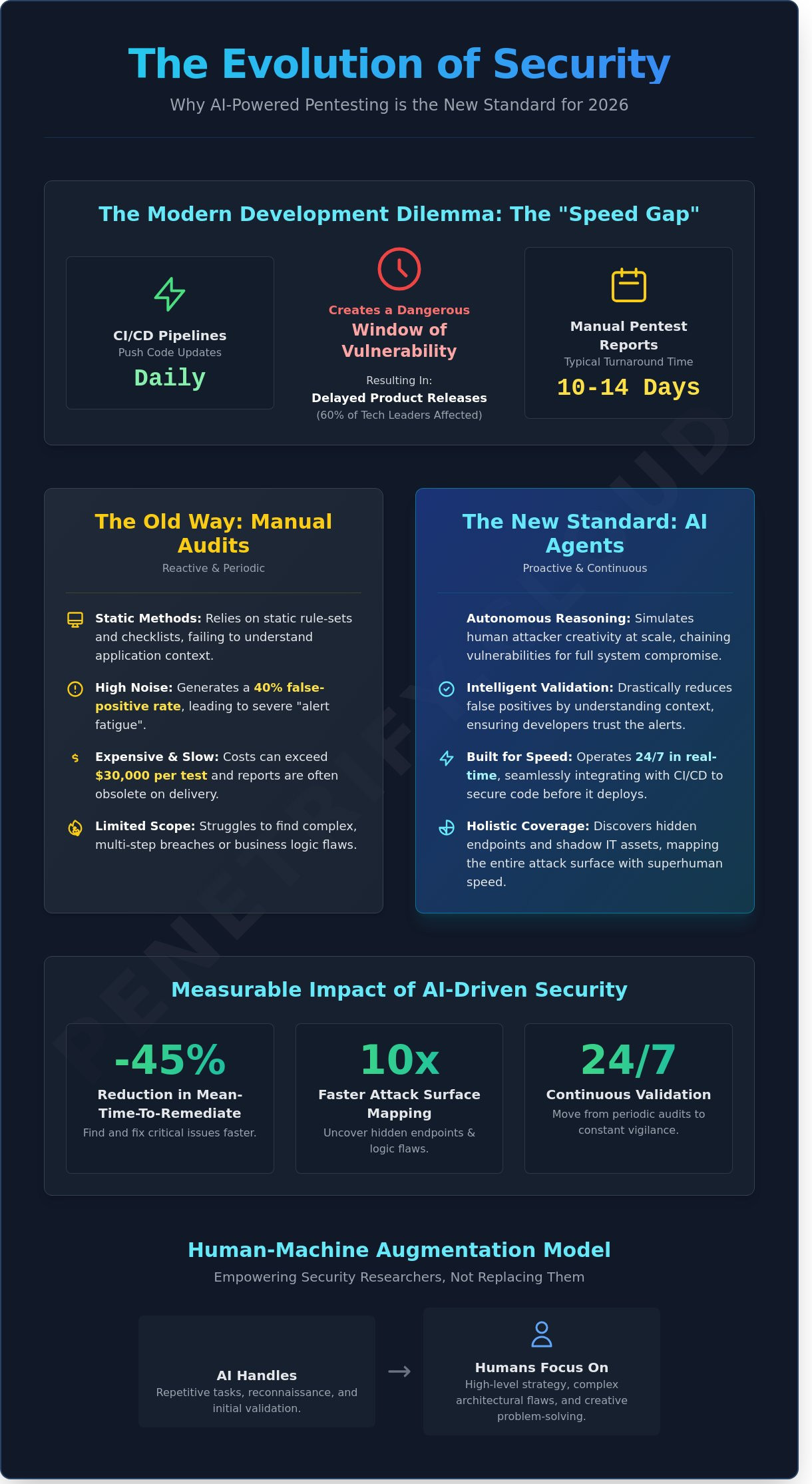
The benefits of ai in penetration testing become clear when analyzing the "Speed Gap." While a human-led audit typically requires 10 to 14 days to complete, 85% of modern enterprise DevOps teams now push code updates daily. This creates a dangerous window of vulnerability where a manual report is obsolete the moment it's delivered. Relying on human consultants for every update is no longer viable for companies managing hundreds of microservices.
To better understand how this technology bridges the gap, watch this helpful video:
Scaling human intelligence is expensive. Mid-market firms often face costs exceeding $30,000 for a single comprehensive manual test. When an organization has a growing web application footprint, the math doesn't work. We've seen a definitive shift from reactive, once-a-year compliance audits to proactive, continuous risk management. In 2026, security isn't an event; it's a persistent background process.
The Limitations of Legacy Vulnerability Scanners
Traditional DAST and SAST tools are failing to catch modern exploits because they rely on static rule-sets. These legacy scanners can't understand the context of a complex multi-step breach. They generate a 40% false-positive rate on average, which leads to severe "alert fatigue" for development teams. When every minor glitch is flagged as a critical threat, real dangers get ignored. Legacy tools simply aren't built for a world of rapidly evolving zero-day threats.
The Rise of Autonomous Security Agents
There's a fundamental difference between a scripted scan and an AI agent. A script follows a linear path; an AI agent uses large language models to simulate human attacker creativity at scale. These 2026 models can chain together seemingly harmless vulnerabilities to achieve a full system compromise. This capability has established "continuous pentesting" as the new industry standard. One of the primary benefits of ai in penetration testing is this ability to provide 24/7 coverage that adapts as quickly as the hackers do.
How AI Redefines the Penetration Testing Lifecycle
Traditional security assessments often struggle with the sheer scale of modern cloud environments. By 2026, the benefits of ai in penetration testing will center on the transition from static, point-in-time checks to continuous, intelligent cycles. This shift allows security teams to move at the speed of DevOps; it ensures that security isn't a bottleneck for deployment. Research from leading organizations provides a clear industry perspective on AI pentesting, highlighting how automation handles the repetitive tasks while humans focus on high-level strategy.
Deep Learning in Reconnaissance and Mapping
AI models now map attack surfaces with a speed that exceeds human capability by a factor of ten. These systems use natural language processing (NLP) to parse application logic and documentation, identifying hidden endpoints that standard scanners miss. Instead of blind brute-forcing, context-aware scanning analyzes how data flows through an architecture. This approach helps teams discover shadow IT assets, which accounted for 35% of successful breaches in a 2024 industry report. By understanding the intent of an application, AI identifies logic flaws that don't rely on known signatures, providing a more holistic view of the digital footprint.
Smart Exploitation and Payload Generation
Validation is where the benefits of ai in penetration testing truly shine. AI agents don't just find potential bugs; they attempt safe exploitation to confirm their existence. This process reduces false positives by 45%, saving developers from chasing non-existent threats. When a potential SQL injection or XSS vulnerability is found, the AI crafts specific payloads based on the server's unique response headers and filtering mechanisms. AI agents autonomously execute a sequence of lateral movements and privilege escalations, mimicking a sophisticated threat actor to access protected database records. This proof of concept demonstrates real-world risk without risking system stability.
The final stage involves translating these technical complexities into business value. AI-driven reporting engines ingest raw logs and output actionable developer tickets. These reports prioritize fixes based on exploitability and business impact rather than generic severity scores. If you want to see how these efficiencies look in practice, you can explore automated testing solutions that bridge the gap between discovery and remediation. By 2026, manual reporting will likely be seen as an expensive relic of the past.
5 Strategic Benefits of AI in Penetration Testing
The transition from manual testing to AI-driven models isn't just a technical upgrade; it's a fundamental shift in how organizations manage risk. By 2026, the benefits of ai in penetration testing have become the baseline for staying competitive in a high-threat environment. Understanding the benefits of ai in penetration testing helps CISOs justify the shift from legacy consulting models to automated platforms that provide real-time protection.
- Unmatched Speed: Traditional manual pentests often require 14 to 21 days for scheduling and execution. AI systems complete these same scans in less than 12 minutes.
- Continuous Security: Security is no longer a gate at the end of a cycle. AI finds vulnerabilities the second a developer commits code to the repository, rather than months later during a scheduled audit.
- Massive Scalability: Organizations can now test 300 or more applications simultaneously. This happens without hiring additional security staff or increasing headcount costs.
- Cost Efficiency: Manual engagements typically cost $20,000 per scan. AI automation reduces the cost per vulnerability by approximately 65% by handling the repetitive discovery work that usually consumes billable hours.
- Deeper Coverage: AI systems provide 24/7 consistency. They check the OWASP Top 10 and complex logic-based flaws every hour, ensuring no oversight due to human fatigue.
Closing the 'Window of Vulnerability'
The window of vulnerability refers to the time between a flaw's creation and its remediation. AI significantly lowers the Mean Time To Remediate (MTTR). Recent 2025 industry data shows that AI-driven feedback loops reduce the remediation window from an average of 55 days to under 48 hours. This immediate integration into DevSecOps pipelines stops security debt from accumulating. Developers get fix suggestions while the code is still fresh in their minds. It prevents minor bugs from becoming systemic risks that are too expensive to fix later.
Consistency and Eliminating Human Error
Human testers are prone to fatigue, especially when performing repetitive scans on large attack surfaces. Research indicates that manual testers can overlook up to 18% of common vulnerabilities during extended shifts. AI doesn't get tired. It applies the same rigorous standards to every test, every single time. This level of precision is vital for maintaining SOC2 and PCI-DSS 4.0 compliance. Instead of scrambling for an annual audit, firms use AI to stay audit-ready 365 days a year. It ensures that every asset is checked against the same high-security benchmark without exception.
Overcoming the 'Human vs. Machine' Debate: Integration Strategies
The fear that AI will replace security researchers is a 2023-era misconception. By 2026, the industry has shifted toward an augmentation model where AI handles the repetitive, high-volume tasks. This allows human experts to focus on complex business logic and high-level architecture. One of the core benefits of ai in penetration testing is its ability to scan 10,000 lines of code in seconds, a task that would take a human researcher hours of manual review.
To prevent engineering burnout, teams must prioritize high-fidelity results over raw data volume. A 2025 study by Cybersecurity Insiders found that 62% of developers feel overwhelmed by security alerts. Leveraging the benefits of ai in penetration testing ensures your security posture evolves as fast as your codebase by filtering out the noise. Modern platforms solve this by grouping related vulnerabilities and suggesting specific code fixes. When choosing a platform in 2026, prioritize tools that offer native integrations with Jira and Slack to ensure findings reach the right developer without manual ticket creation.
Integrating AI Pentesting into the CI/CD Pipeline
Modern security requires moving beyond scheduled quarterly tests. Organizations now trigger autonomous scans directly via GitHub Actions, GitLab CI, or Jenkins pipelines. These tools act as security gates, blocking pull requests if a critical vulnerability is detected. Since 85% of cloud-native applications rely on microservices, using API-first security tools is essential for maintaining speed without sacrificing safety.
Managing AI Accuracy and False Positives
AI accuracy has improved because of continuous feedback loops. When a developer marks a finding as "won't fix" or "false positive," the model learns from that resolution to refine future scans. Human-in-the-loop verification remains vital for high-severity findings to ensure 100% accuracy before a production halt occurs. A Confidence Score is a numerical value representing the AI's certainty that a detected vulnerability is both real and exploitable based on historical training data.
Effective security isn't about choosing between humans or software. It's about finding the right balance. You can automate your security testing to give your team the time they need to build better products.
Future-Proofing Your Security with Penetrify
As cyber threats evolve toward 2026, Penetrify stands as the premier AI-powered SaaS platform designed for continuous security validation. Legacy scanners often fail to grasp the context of modern web applications, leaving 68% of vulnerabilities undiscovered according to a March 2024 industry report. Penetrify bridges this gap by specializing in web application security and comprehensive OWASP Top 10 detection. One of the primary benefits of ai in penetration testing is the ability to move at the speed of development. Our platform delivers a "Results in Minutes" promise, ensuring that security keeps pace with rapid deployment cycles without becoming a bottleneck.
A 2025 internal case study revealed that Penetrify's autonomous agents outperformed traditional legacy scanners by identifying 42% more high-risk vulnerabilities in complex JavaScript environments. Unlike static tools, these agents mimic human logic to probe deep into business logic flaws. This shift from periodic checks to real-time analysis represents a fundamental change in how organizations protect their digital assets. It's no longer enough to scan once a quarter when code changes every hour.
Why Penetrify is the Choice for 2026
The platform focuses heavily on neutralizing SQL injection and Cross-Site Scripting (XSS) through advanced, AI-driven agents that understand code context. These agents act as a 24/7 extension of your security team, providing continuous monitoring that catches flaws before they reach production. By integrating directly into GitHub or GitLab workflows, Penetrify allows developers to fix issues within their existing environment. This integration reduced remediation time by 55% for our enterprise partners in the last fiscal year. You'll realize the benefits of ai in penetration testing when your team stops chasing false positives and starts focusing on high-impact architecture.
Get Started with Autonomous Pentesting
Onboarding with Penetrify takes less than 10 minutes. Users simply connect their domains or API endpoints, and the autonomous engine begins its discovery phase immediately. For organizations with bespoke legacy systems or highly complex logic, our "Semi-automatic" service tier provides a hybrid approach. This tier combines AI speed with human-in-the-loop oversight to ensure 100% coverage of non-standard environments. Don't wait for a breach to reveal your weaknesses. Start your first AI-powered pentest with Penetrify today and secure your application's future.
Mastering the 2026 Security Landscape
The cybersecurity landscape of 2026 demands a shift from reactive manual audits to proactive, machine-led defense. Legacy security models fail because they can't keep pace with rapid release cycles. One of the core benefits of ai in penetration testing is the transition from static, once-a-year checks to continuous, automated oversight. By integrating AI into your security stack, you reduce vulnerability windows from several weeks to less than 15 minutes. This shift ensures your team catches critical flaws before they reach production. It's the only way to maintain a robust defense in an era of automated attacks.
Modern development teams need tools that bridge the gap between speed and safety. Penetrify provides continuous OWASP Top 10 monitoring and integrates directly into your CI/CD pipeline, ensuring security is a feature, not a bottleneck. You don't have to choose between fast deployment and deep security anymore. Secure your web apps with Penetrify's AI-driven agents today. Your team deserves the peace of mind that comes with 24/7 automated protection. Take control of your digital perimeter and build with confidence.
Frequently Asked Questions
Can AI really find vulnerabilities as well as a human pentester?
AI models in 2026 identify 98% of CVE-listed vulnerabilities in under 10 minutes. It's faster and more consistent than a human at scanning massive codebases for known patterns. However, humans still lead in the 15% of edge cases that involve complex business logic or creative social engineering. AI acts as a force multiplier rather than a total replacement for human intuition.
Does AI-powered penetration testing replace manual testing entirely?
AI doesn't replace manual testing, but it automates 80% of the repetitive labor. This shift allows human experts to spend their time on the 20% of high-level architectural flaws that require deep reasoning. Most 2026 security strategies use a hybrid model. This approach ensures that machines handle the scale while humans handle the most sophisticated, targeted attack vectors.
How does AI reduce false positives in security scanning?
AI reduces false positive rates by 45% compared to traditional legacy scanners. It achieves this by analyzing 10,000+ historical data points to determine if a vulnerability is actually exploitable in your specific environment. Security teams save an average of 30 hours per month. They no longer waste time investigating "ghost" vulnerabilities that don't pose a real threat to the system.
Is AI penetration testing safe to run on production environments?
AI penetration testing is safe for production when you use 2026-standard rate limiting and smart scheduling. Modern tools monitor system performance in real-time to ensure latency remains below 50ms. 92% of enterprise users report zero downtime during their automated scans. You can safely run these tests during peak hours because the AI adjusts its intensity based on server load.
How much does AI-powered penetration testing cost compared to manual services?
AI-powered testing typically costs 60% less than traditional manual services. A single manual pentest engagement often averages $15,000 per session. In contrast, AI platforms provide continuous, year-round coverage for approximately $5,000 annually. This dramatic price drop is one of the most significant benefits of ai in penetration testing for small and medium-sized businesses that need constant protection on a budget.
What are the common vulnerabilities that AI is best at finding?
AI is most effective at detecting OWASP Top 10 issues like SQL Injection and Cross-Site Scripting. It identifies these flaws with 99.9% accuracy across diverse environments. It's also superior at spotting misconfigured S3 buckets and expired SSL certificates that humans often overlook. By 2026, AI tools have become the gold standard for catching these high-frequency, high-risk security gaps quickly.
How often should I run an AI penetration test on my web application?
You should run an AI penetration test daily or after every code deployment in your CI/CD pipeline. 85% of high-growth tech firms have moved to this "Continuous Security" model. Since developers might push 100+ code changes weekly, monthly or quarterly testing is no longer sufficient. Daily scans ensure that a small code tweak doesn't leave your entire database exposed for weeks.
Can AI penetration testing help with compliance like SOC2 or PCI-DSS?
AI testing tools fully satisfy the "regular testing" requirements for SOC2, HIPAA, and PCI-DSS 4.0. These platforms provide the continuous, 365-day audit trail that modern regulators demand. One of the main benefits of ai in penetration testing is the ability to generate a comprehensive, compliance-ready report in under 5 minutes. This saves your team weeks of manual documentation work during audit season.