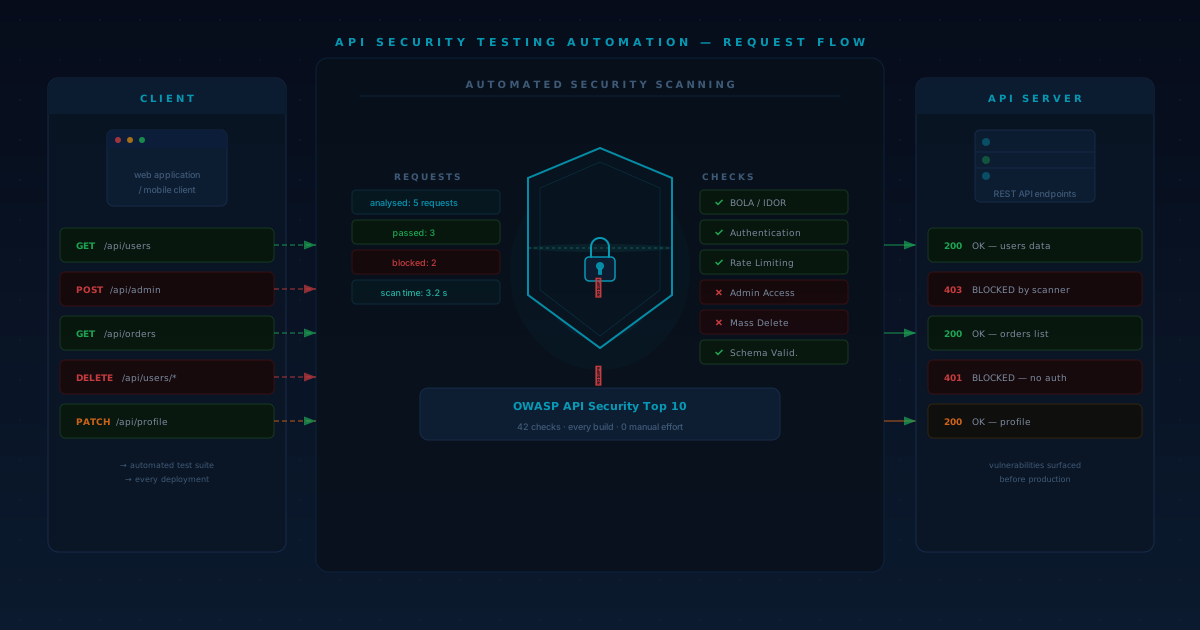
If you spend enough time looking at cloud infrastructure, you start to realize it's a bit like a house that’s constantly being renovated while you’re living in it. You add a new room (an S3 bucket), change the locks (IAM policies), and maybe open up a window for a friend (an API gateway). But in the rush of digital transformation, it’s incredibly easy to leave a door unlocked or forget that a window even exists.
Most organizations today aren't operating on a static "perimeter." The old days of building a big wall around your office server room are gone. Now, your data is scattered across AWS, Azure, or Google Cloud, accessed by remote employees, third-party integrations, and automated scripts. This complexity is where security blind spots live. You might think your configuration is tight because your dashboard shows "all green," but a dashboard only tells you what it's programmed to look for. It doesn't tell you how a creative attacker might chain three "minor" misconfigurations together to steal your customer database.
This is where penetration testing comes in. It’s not just about checking boxes for a compliance audit—though that’s a part of it. It’s about stress-testing your assumptions. It’s about asking, "I think this is secure, but can someone prove me wrong?" In this guide, we’re going to look at why cloud security is so tricky, how to identify the gaps you didn’t know you had, and how platforms like Penetrify are making this process manageable for teams that don't have an army of security researchers on staff.
Why Technical Debt and Rapid Scaling Create Security Gaps
In the tech world, we often talk about "moving fast and breaking things." While that’s great for innovation, it’s a nightmare for security. When a developer needs to push a feature by Friday, they might temporarily open an Security Group to "all traffic" just to get a database connection working. They promise themselves they’ll go back and tighten it up on Monday. Monday comes, a new fire starts, and that open port stays open for six months.
That’s a classic security blind spot. It isn't a failure of technology; it's a failure of visibility. As your cloud footprint grows, your manual ability to track every change disappears.
The Illusion of "Default" Security
Many teams fall into the trap of thinking that because they use a major cloud provider, security is "handled." This is the Shared Responsibility Model. The provider secures the physical data centers and the underlying hypervisor. You are responsible for everything inside your instances, your data, and—most importantly—your identity and access management (IAM).
A common blind spot occurs when teams assume default settings are sufficient. Default settings are usually designed for ease of use, not maximum lockdown. If you haven't explicitly hardened your environment, you likely have "over-privileged" accounts where an intern’s credentials have the power to delete an entire production environment.
Shadow IT and Ghost Resources
Another major contributor to blind spots is "Shadow IT." This happens when a department—say, Marketing—spins up their own cloud instance or uses a third-party SaaS tool without telling the IT or security team. Maybe they’re testing a new landing page tool. If that tool has a vulnerability, it becomes a back door into your broader corporate network. Penetration testing helps find these "unmanaged" assets by scanning your entire digital footprint, not just the parts documented in your official inventory.
Common Cloud Blind Spots You Might Be Missing
To fix a problem, you have to know what it looks like. Let's talk about the specific areas where cloud environments typically fail. These aren't just theoretical; these are the entry points attackers use every single day.
1. Misconfigured Storage Buckets
It feels like a cliché at this point, but "leaky buckets" are still a top cause of data breaches. Setting an S3 bucket or an Azure Blob to "Public" is often a one-click mistake. What makes this a blind spot is that the data might not be indexed by Google, so you don't realize it's public until a security researcher (or a hacker) stumbles upon it using an automated tool.
2. Over-Privileged IAM Roles
Identity and Access Management is the new perimeter. In a cloud environment, an identity isn't just a person; it's a server, a lambda function, or an application. If a web server has a role that allows it to "Describe" all other resources in your account, an attacker who compromises that web server can now map out your entire network. This is known as lateral movement. Most companies have far too many "Administrator" roles assigned to accounts that only need read-only access.
3. Orphaned Snapshots and Backups
When you delete a virtual machine, the backup snapshots often remain. These snapshots contain a full copy of your data from that time. If those snapshots aren't properly encrypted or have lax access controls, they are a goldmine for attackers. Deep-dive penetration testing looks for these forgotten assets.
4. API Keys in Source Code
Developers often hardcode API keys or secrets into their scripts for convenience. If that code is pushed to a repository (even a private one), those keys are now a liability. If the repository is ever compromised or accidentally made public, your cloud credentials are out in the wild in seconds.
How Penetration Testing Differs from Vulnerability Scanning
A lot of people use the terms "vulnerability scanning" and "penetration testing" interchangeably, but they are very different tools.
Vulnerability scanning is like a security guard walking through a hallway and checking if the doors are locked. It’s automated, fast, and great for finding known issues (like an unpatched version of Linux).
Penetration testing, on the other hand, is like hiring a professional locksmith to see if they can get into the building. The pentester doesn't just look for an unlocked door; they look for a loose vent, a social engineering trick to get a key, or a way to pick the lock.
The "Chain" Effect
The most dangerous vulnerabilities aren't usually single, high-severity bugs. They are "chains" of medium-severity issues. For example:
- An attacker finds a public-facing web server with a minor info-leak bug.
- They use that info to find the name of an internal server.
- They exploit a misconfigured IAM role on the web server to send a command to the internal server.
- The internal server has an unpatched vulnerability that allows for data extraction.
A vulnerability scanner might flag these as individual "Medium" risks. A penetration test (like the ones facilitated by Penetrify) will actually execute the chain to show you that these three minor things actually lead to a total data breach.
The Role of Penetrify in Modern Security Workflows
For many middle-market companies, the traditional way of doing penetration testing is broken. You hire a boutique firm, wait three weeks for them to start, they spend a week testing, and then they give you a 100-page PDF report that is outdated the moment you receive it. By the time you fix the first five bugs, your developers have pushed ten more updates, changing the landscape entirely.
Penetrify changes this by offering a cloud-native platform that merges automated scanning with professional-grade depth.
Scalability on Demand
If you have five apps or five hundred, your security testing needs to scale accordingly. Because Penetrify is cloud-based, you don't have to install heavy appliances in your data center. You can launch assessments across your entire infrastructure simultaneously. This is particularly useful for organizations moving through digital transformations where the environment is constantly expanding.
Remediation, Not Just Reporting
Finding a hole is easy; fixing it is the hard part. Penetrify provides clear, actionable guidance on how to remediate vulnerabilities. Instead of a vague "fix your firewall," you get specific instructions often tailored to the exact environment you’re running. This helps IT teams act quickly without needing to be security PhDs.
Continuous Monitoring
The "point-in-time" model of security is dead. A pentest on January 1st doesn't protect you from a vulnerability introduced on January 15th. Penetrify allows for more regular, recurring assessments. It’s about building a "security muscle" where you are constantly testing your defenses rather than waiting for an annual audit.
Step-by-Step: Conducting Your First Cloud Penetration Test
If you’re ready to start uncovering these blind spots, you need a plan. Walking into a pentest without a strategy is a waste of money and time. Here is how you should approach it:
Step 1: Define Your Scope
Don't just say "test everything." Start with your most critical assets. Where is the "crown jewel" data? Is it in a specific database? A specific application? Define the IP ranges, URLs, and cloud accounts that are in scope. Make sure you also define what is out of scope (like third-party APIs you don't own).
Step 2: Inform Your Stakeholders
Ensure your IT team and cloud providers know a test is happening. While you want to simulate a real attack, you don’t want your internal team to shut down production because they think a real breach is occurring. Note: Most major cloud providers no longer require prior notification for standard pentests, but it’s always worth checking their latest policy.
Step 3: Choose Your Testing Style
- Black Box: The tester has no prior knowledge of your systems. This simulates an external hacker.
- White Box: The tester has full access to blueprints, code, and network diagrams. This is the most thorough.
- Grey Box: A mix of both, often providing the tester with a standard user login to see what an "insider" or a compromised customer could do.
Step 4: Run the Assessment via Penetrify
Using a platform like Penetrify, you can initiate these tests. The platform will look for configuration errors, weak passwords, unpatched software, and logic flaws in your applications.
Step 5: Analyze and Prioritize
You will get a list of findings. Do not try to fix everything at once. Focus on the "Critical" and "High" risks that have a clear path to your sensitive data. Use the remediation guides to assign tasks to your developers or sysadmins.
Common Myths About Penetration Testing
There are a lot of misconceptions that prevent companies from doing the testing they need. Let’s clear a few up.
"We're Too Small to Be a Target"
Hackers don't always target specific companies. Often, they use bots to scan the entire internet for specific vulnerabilities (like an open port or an old version of WordPress). They don't care if you're a Fortune 500 or a local bakery; if your data is easy to steal, they’ll steal it. In fact, smaller companies are often preferred because their defenses are usually weaker.
"Pentesting Will Break Our Services"
Modern penetration testing is very controlled. Professional testers (and automated platforms like Penetrify) use "non-destructive" methods. They identify that a door can be opened without actually kicking it down. You can also schedule tests during low-traffic periods to ensure zero impact on your customers.
"Compliance is Enough"
Being compliant with SOC 2 or PCI-DSS means you’ve met a minimum baseline. It doesn't mean you're secure. Compliance is about following rules; security is about defending against an evolving threat. A pentest looks for the gaps that the compliance checklist missed.
Case Scenario: The "Forgotten" Dev Environment
To illustrate how these blind spots work in the real world, let's look at a hypothetical scenario common in many mid-sized enterprises.
The Situation: A software company has a very secure production environment. It’s firewalled, uses multi-factor authentication (MFA), and is regularly audited. However, three years ago, a developer spun up a "Dev-Test" environment in the same cloud account to try out a new database. They used a simple password and didn't enable MFA because "it was just for testing."
The Blind Spot: The Dev-Test environment was forgotten. It wasn't part of the regular security reviews because it wasn't "Production."
The Attack: An attacker finds the Dev-Test environment through a simple IP scan. They brute-force the easy password. Once inside, they realize the Dev-Test environment has a peering connection to the Production environment (a common setup for data migration). Using the credentials found in the Dev environment's configuration files, the attacker moves laterally into the Production database.
The Solution: A penetration test through Penetrify would have identified that "zombie" environment immediately. By scanning the entire cloud account—not just the known production IPs—the platform would have flagged the weak password and the unnecessary connection between Dev and Production, allowing the team to shut it down before an attacker found it.
The Financial Impact of Unseen Vulnerabilities
Security is often seen as a cost center, but the reality is that it’s an insurance policy. The cost of a single breach—including legal fees, forensic investigations, notification costs, and brand damage—usually dwarfs the cost of a decade's worth of penetration testing.
Reducing Insurance Premiums
Many cyber insurance providers now require proof of regular penetration testing before they will issue a policy. By using a platform like Penetrify to maintain a documented history of assessments and remediations, you can often negotiate better rates or broader coverage.
Avoiding Regulatory Fines
Under regulations like GDPR or HIPAA, failing to conduct regular security assessments can be seen as "negligence." If a breach occurs and you haven't done a pentest in years, the fines are significantly higher than if you can show you were actively trying to find and fix vulnerabilities.
How to Build a "Security-First" Culture
Tools and platforms are essential, but the ultimate goal is to change how your team thinks about the cloud.
- Include Security in the Design Phase: Don't wait until an app is finished to test it. Think about the security implications while you're still drawing diagrams.
- Reward the "Finders": If a developer finds a security hole in their own code, thank them. Don't punish them for the mistake. You want people to be proactive.
- Automate the Boring Stuff: Use Penetrify for the repetitive, broad-scale scanning so your human experts can focus on the complex, unique logic of your business.
- Educate Non-Technical Staff: Security is everyone's job. Make sure everyone understands that a single phished API key can take down the whole platform.
A Technical Deep Dive: What Pentesters Actually Look For
When you use a sophisticated platform or a manual tester, they are following a methodology. In the cloud, this usually follows the OWASP Top 10 or the CIS Benchmarks. Here are some technical specifics that are often uncovered:
Server-Side Request Forgery (SSRF)
This is a king-level vulnerability in cloud environments. It allows an attacker to make the server perform a request on their behalf. In the cloud, this is often used to query the "Metadata Service." If successful, an attacker can pull the temporary credentials (IAM keys) of the server itself.
Insecure Direct Object References (IDOR)
This happens when an application provides access to data based on a user-provided input. For example, if you can see your profile at example.com/api/user/123, an IDOR vulnerability allows you to change that to 1234 and see someone else’s data. This is a logic flaw that standard scanners often miss but penetration testing catches.
Unencrypted Data at Rest and in Transit
While most cloud providers offer encryption, it’s not always turned on. Pentesters check to see if your databases, disks, and backups are encrypted with keys that you manage (CMKs). They also check if your internal traffic—between your web server and your database—is encrypted. If it's not, an attacker who gets a foot inside can "sniff" the traffic and steal passwords in plain text.
Frequently Asked Questions (FAQ)
Does penetration testing fulfill SOC 2 requirements? Yes, most auditors require or strongly recommend a formal penetration test to meet the "Security" trust principle of SOC 2. Penetrify provides the reports you need to show auditors that you are proactively managing risks.
How often should we perform a penetration test? At a minimum, once a year. However, in a fast-moving cloud environment, "Continuous" or "Quarterly" testing is becoming the standard. You should also run a test whenever you make a major change to your infrastructure or release a significant new feature.
Can we perform pentesting ourselves? You can run your own scans, but a true penetration test usually requires a third-party perspective. It’s hard to find your own mistakes because you have the same "blind spots" that created the vulnerability in the first place. Using an external platform like Penetrify satisfies the need for an objective third-party assessment.
How long does a typical cloud pentest take? Using traditional methods, it could take weeks. With Penetrify’s automated-manual hybrid approach, you can start getting results in a matter of days, and sometimes hours for automated scans.
What is the difference between a "Bug Bounty" and a "Pentest"? A bug bounty is an open invitation for hackers to find bugs in exchange for money. It’s great but can be unpredictable. A pentest is a structured, deep-dive evaluation of a specific scope with a guaranteed report and methodology. Pentesters are often more thorough at finding "boring" but critical configuration issues that bounty hunters might ignore.
Summary Checklist: Finding Your Blind Spots
If you’re feeling overwhelmed, start here. Check these five things today:
- Review your IAM Users: Delete any accounts that haven't logged in for 90 days.
- Check S3/Blob Permissions: Ensure no buckets are set to "Public" unless they are intentionally hosting a public website.
- Enable MFA Everywhere: No exceptions. Even for the "test" accounts.
- Audit Your Security Groups: Ensure only necessary ports (like 443 for HTTPS) are open to the internet. Close port 22 (SSH) and 3389 (RDP) to the general public immediately.
- Run a Discovery Scan: Use a tool or platform like Penetrify to find assets you didn't know you had.
Final Thoughts: Staying Ahead of the Threat
The cloud is a powerful tool, but its fluid nature means that security is never "done." It’s an ongoing process of discovery and refinement. Blind spots aren't a sign of a bad engineering team; they are an inevitable side effect of growth and complexity.
The goal isn't to be perfect. The goal is to be harder to break than the next guy. By incorporating regular penetration testing into your workflow, you take the power away from the attackers. You find the open window before they do.
If you're looking for a way to simplify this, Penetrify offers the tools and expertise to help you see your infrastructure through the eyes of an attacker. Don't wait for a "pivotal moment" like a data breach to start taking this seriously. Start looking for your blind spots today, while you still have the time to fix them.
Ready to see what you've been missing? It might be time to stop guessing and start testing. Explore how Penetrify can secure your cloud journey and give your team the peace of mind that comes from knowing your defenses actually work.