AI Penetration Testing That Thinks Like an Attacker, Not a Scanner
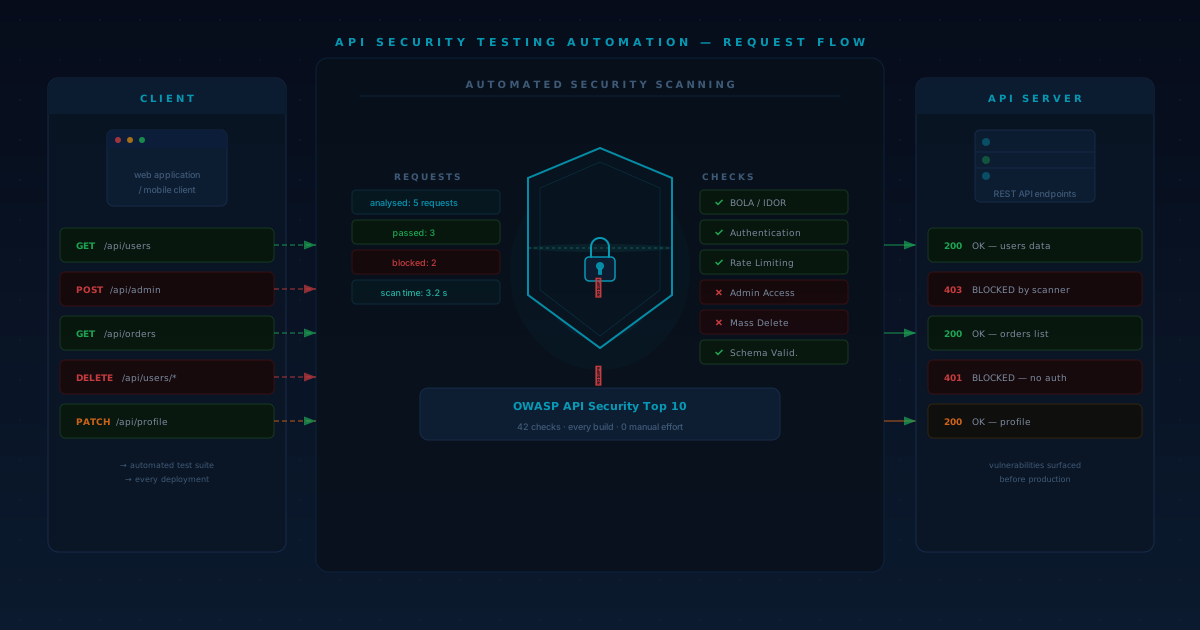
Traditional scanners replay static payloads. AI penetration testing reasons about your application's behavior, chains vulnerabilities together, and validates every finding through actual exploitation. OWASP Top 10 coverage on every deployment, not once a quarter.
The problem
Why Traditional Pentesting Can't Keep Pace
Quarterly pentests leave 364 days unprotected
Your team ships code daily. Between quarterly assessments, every new endpoint, modified auth flow, and changed dependency goes untested. Attackers don't wait for your next engagement window.
Scanners find 40–70% of what's actually there
Pattern-based DAST scanners miss business logic flaws, authorization bypasses that require multiple user sessions, and multi-step attack chains. They find the easy vulnerabilities and miss the critical ones.
Manual testers are a bottleneck
Skilled penetration testers are expensive, hard to schedule, and limited by time. The average engagement lasts days: not enough to continuously cover an application that changes every sprint.
How it works
How AI Penetration Testing Works
OWASP Top 10 coverage
Full OWASP Top 10 Coverage: Including What Scanners Can't Reach
Broken Access Control
Authenticated session testing with your test account and an intended-role model, across every endpoint: IDOR, privilege escalation, CORS misconfiguration.
Cryptographic Failures
TLS configuration, data-in-transit exposure, client-side secret detection.
Injection
Context-aware SQL, NoSQL, OS, LDAP, SSTI payloads adapted to your stack.
Insecure Design
Business logic flaw detection through behavioral workflow analysis.
Security Misconfiguration
Framework settings, server headers, cloud storage permissions, default credentials.
Vulnerable Components
Dependency CVE matching plus exploitability validation in your context.
Auth Failures
Credential stuffing, session fixation, JWT flaws, MFA bypass testing.
Integrity Failures
Deserialization attacks, CI/CD pipeline integrity, supply chain validation.
Logging Failures
Security event logging gaps, audit trail completeness validation.
SSRF
Server-side request forgery with internal network discovery and exploitation.
Comparison
AI Penetration Testing Compared
| Capability | Manual Pentest | DAST Scanner | Penetrify |
|---|---|---|---|
| Testing frequency | Quarterly | Per build | Every deployment |
| Business logic testing | Yes | No | Yes (AI-driven) |
| Multi-step chains | Yes (time-limited) | No | Yes (automated) |
| False positive rate | Low | 30–60% | Under 10% |
| Time to results | Days to weeks | 15–60 min | 15–30 min |
| CI/CD integration | No | Limited | Native |
| Proof-of-exploit | Yes | No | Yes |
| Coverage as app grows | Decreases | Static | Scales automatically |
Who uses it
AI Penetration Testing for Every Team
DevSecOps teams
Integrate continuous AI pentesting into your pipeline. Every PR is tested before it ships. Developers get findings as inline PR comments with reproduction steps.
Security teams
Replace quarterly manual assessments with continuous coverage. Focus human expertise on architectural review. Let AI handle repeatable OWASP testing.
Compliance-driven organizations
Meet SOC 2, PCI DSS, ISO 27001, and HIPAA penetration testing requirements with validated, documented findings that satisfy auditors.
SaaS companies
Protect multi-tenant architectures continuously. Test tenant isolation and authorization boundaries on every deployment before a breach exposes customer data.
FAQ
AI Penetration Testing Questions
Related pages
Guides
Featured guides
Get started
Run Your First AI Penetration Test in Minutes
No credit card required. Connect your application and see your first AI-powered findings before end of day.