Your Scanner Found 200 Vulnerabilities. It Missed the One Attack Path That Matters.
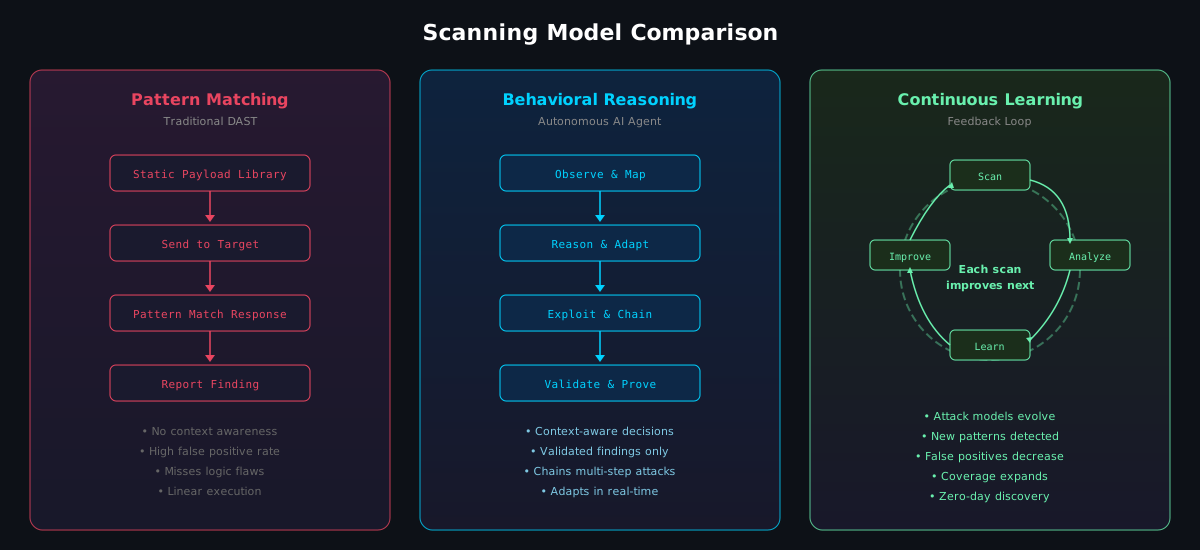
Vulnerability scanners report individual findings. Attackers chain them together. The Ivanti CSA breach used four moderate vulnerabilities, none rated critical alone, to achieve full system compromise. Penetrify simulates multi-step attack chains the way real attackers operate: discovering a weakness, leveraging it for deeper access, and chaining exploits until reaching your most sensitive data.
The problem
Flat Vulnerability Lists Hide Real Risk
Attackers don't exploit single vulnerabilities
They chain them. An information disclosure leak reveals an internal endpoint. A broken authorization check on that endpoint exposes credentials. Those credentials unlock an admin panel with a code execution flaw. Three medium-severity findings. One critical attack path. Your scanner reported all three. It never connected them.
CVSS scores lie without context
A CVSS 5.0 information disclosure is medium. A CVSS 4.0 authorization bypass is medium. Combined, they're a critical path to your production database. Severity scores evaluate findings in isolation. Attackers evaluate them in combination.
You're fixing the wrong things first
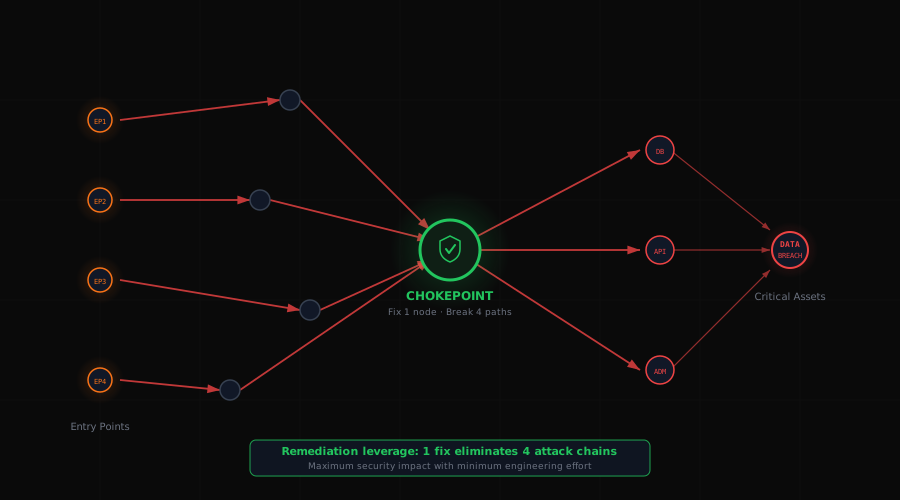
Without chain analysis, remediation follows CVSS order. But the medium-severity finding that sits at the chokepoint of five attack chains is more important than the high-severity finding on an unreachable internal endpoint. Flat lists can't tell you which is which.
How it works
How Penetrify Simulates Multi-Step Attack Chains
What it finds
What Scanners Miss, Penetrify Finds
Chained authorization exploits
An API endpoint leaks internal user IDs through verbose error messages. A separate endpoint has broken object-level authorization that accepts any user ID without validation. Neither finding is critical alone. Together, they expose your entire user database. Penetrify discovers this chain by actually exploiting the first finding and using the leaked IDs to probe the second.
Cross-service lateral movement
A microservice with a low-severity SSRF vulnerability can reach an internal service that has no authentication. That internal service has read access to a configuration store containing database credentials. Three services, three separate findings, one path to your production data. Scanners test each service independently. Penetrify follows the path across service boundaries.
Framework-level attack chains
The 2025 Craft CMS zero-day chain exploited a vulnerability in Craft CMS itself and a separate vulnerability in the underlying Yii framework. Attackers leveraged the application-level flaw to reach the framework-level flaw, a connection that scanners testing either layer independently would never discover.
Business logic exploitation sequences
A race condition in session management briefly exposes another user's session token. Most endpoints validate tenant context, so the stolen token alone isn't useful. But one legacy reporting endpoint skips tenant validation. The chain: exploit the race condition, capture a cross-tenant token, hit the legacy endpoint, and gain full cross-tenant data access.
Pipeline integration
Continuous Chain Analysis in Your CI/CD Pipeline
Connection check (2–5 min)
Tests whether changed endpoints create new connections in the attack graph. If a new endpoint bridges two previously disconnected vulnerable components, the finding surfaces immediately as a PR comment.
Chain validation (10–20 min)
Runs targeted chain simulation on affected service boundaries. Validates that existing chains still work (or confirms that a fix broke them) and tests for new chains involving changed components.
Full graph exploration (30–90 min)
Comprehensive multi-step attack chain simulation across the entire application surface. Discovers complex chains that span many components, validates all critical paths end-to-end, and updates chokepoint rankings.
Where developers work
Chain findings appear as PR comments with the full attack path: step 1 → step 2 → step 3 → objective. Each step includes the specific vulnerability, the endpoint, and what the step enables. Developers see not just what's broken, but why it matters.
Comparison
Multi-Step Attack Chain Simulation Compared
| Capability | Vuln Scanner | Manual Pentest | BAS Tools | Penetrify |
|---|---|---|---|---|
| Individual vulnerability detection | Yes | Yes | Limited | Yes |
| Chain discovery | No | Yes (time-limited) | Pre-scripted only | AI-powered, novel chains |
| Business logic chains | No | Yes | No | Yes |
| Cross-service chains | No | Sometimes | No | Yes |
| Chokepoint analysis | No | Sometimes | No | Automated |
| MITRE ATT&CK mapping | No | Manual | Yes | Automated |
| CI/CD integration | Limited | No | Limited | Native |
| Testing frequency | Per build | Quarterly | Scheduled | Every deployment |
| Time to results | Minutes | Weeks | Hours | 2–5 min (fast tier) |
Who uses it
Who Uses Multi-Step Attack Chain Simulation
Security teams
Use chain analysis to move beyond CVSS-driven remediation and focus engineering effort on the fixes that eliminate the most risk. Chokepoint reports give CISOs a concrete answer to "what should we fix next?"
DevSecOps engineers
Integrate chain checks into CI/CD pipelines to catch new attack paths before they reach production. Chain-aware quality gates prevent deployments that create critical exploitation paths.
Compliance teams
Use MITRE ATT&CK-mapped chain reports to demonstrate security control coverage and identify gaps. The attack graph provides evidence that defensive controls are validated against realistic attack scenarios, not just theoretical checklists.
Penetration testers
Use Penetrify chain analysis to focus manual engagements on the highest-risk areas. Instead of broad-scope quarterly assessments, testers validate and extend the most critical chains the AI discovered.
FAQ
Attack Chain Simulation Questions
Guides
Featured guides
Get started
See Your Attack Chains in 24 Hours
Free trial, no credit card required. Connect your application and see your first attack graph: the chains that exist today, ranked by severity and chokepoint impact.